

Why your declutter should change how you shop (part 1 of 2)
If you’ve ever donated a bag of clothes and then mysteriously re-bought the same problem in a different color, you’re not bad at shopping. You’re missing the bridge between clearing out and letting new things in. I see it all.the.time. A “decluttering clothes checklist” is that bridge, because it doesn’t just ask “keep or toss”. Filled out, it captures the reason each piece didn’t work and you turn that into a rule you can use before anything earns hanger space again.
This is Part 1 of a two-part system using this printable PDF.
Today: track your reasons and build your entry rules.
Friday: get the action grid that helps you sort fast without spiraling.
Together, they become a two-sided printable you can reuse every cleanout session and every time you’re tempted by a “maybe” in a fitting room. This is the real value.
Most people declutter on emotion: guilt, shame, or sudden motivation to “be better.” That energy fades fast. Without written reasons that become your own rules, you’re free to repeat the same patterns next time you’re bored online or standing in front of a sale rack. Instead, treat every item you release as data. You’re not failing. You’re gathering proof about what your real life, real body, and real preferences actually say yes to, and AMC is the bridge because your Lookbook shows what you really wear on your real body.
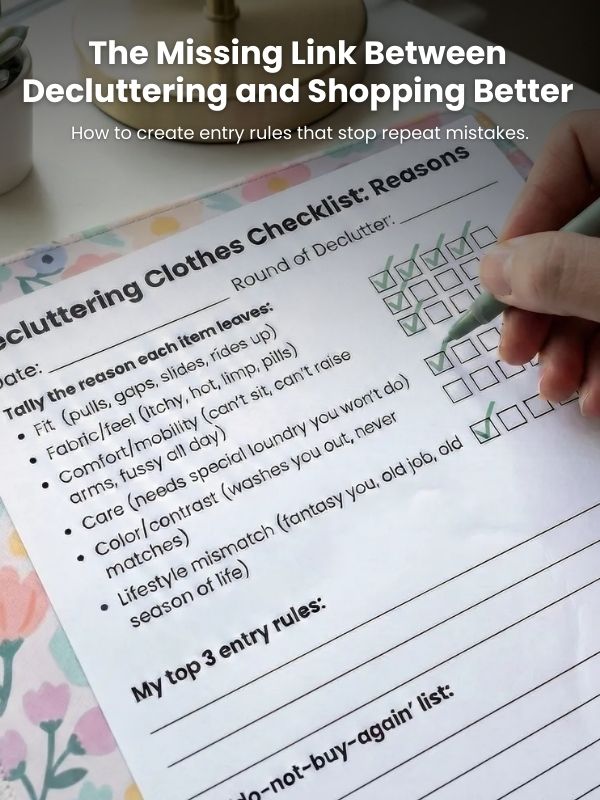
Side 1 of the printable: the six-reason tracker
This is your tracker: six clear reasons, each with a box so you can tally every time something leaves your closet for that reason (and space for your own reasons, just in case). By the end, you’ll see which category is most checked and that’s your biggest shopping weak spot. This is a “decluttering idea for clothes” checklist that actually sticks because you’re not just purging for space, you’re building a custom rulebook.
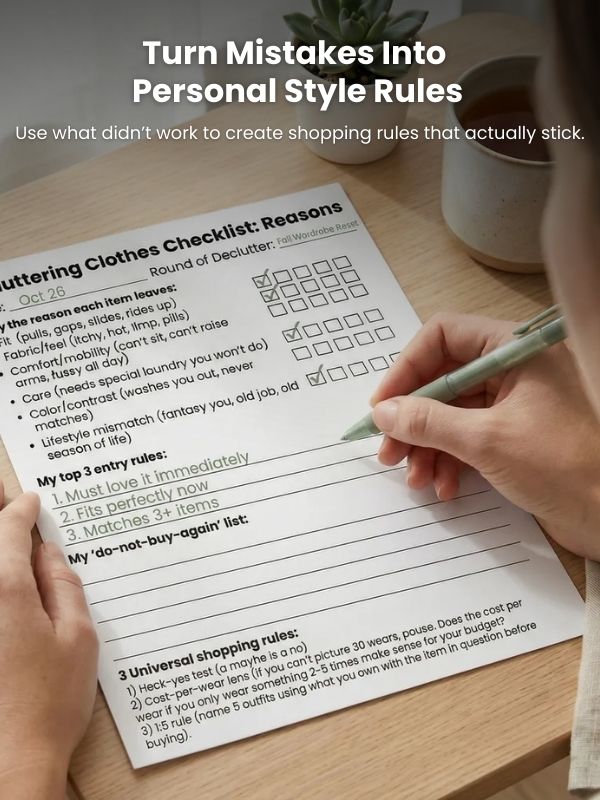
As each item goes into the “out” pile, choose one reason and make a tally mark. At the bottom, there is space for “My top 3 entry rules.” This becomes evidence, the same way your AMC Lookbook is full of Collections that are evidence of what you really wear day to day. Having your own rules, based on your decluttering, changes how to shop for clothes.
Turn your declutter reasons into personal “how to shop for clothes” rules
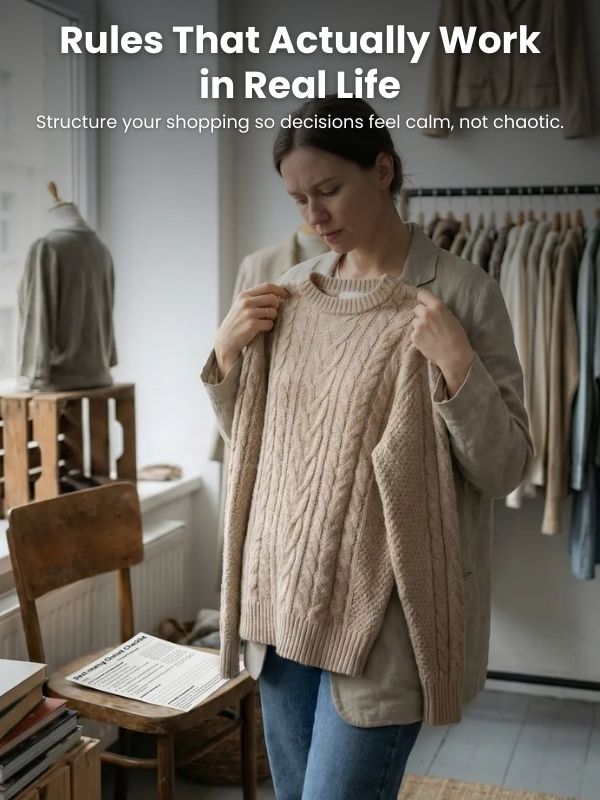
Now convert each reason into a personal “how to shop for clothes” rule: a one-sentence filter that every new item has to pass. If you can’t say it quickly, it won’t help you in a fitting room. This is where how you shop for clothes changes: you’re relying on rules your own closet already proved. The rules just help you remember (the same way daily pics in AMC help you remember what you actually wear and well styled outfits and what you wear in certain temperatures…).
Personal Rule Examples:
Fit reason: “The waistband rolls when I sit.”
Entry rule: “No waistbands that roll; I always do a sit test. I need comfortable clothes.”
Care reason: “Dry clean only turned into ‘never worn.'”
Entry rule: “I only buy pieces that fit laundry I already do.”
Color reason: “This shade makes me look tired.”
Entry rule: “I buy colors that work with my bare face and go-to shoes”
Lifestyle reason: “This belongs to a life I don’t live.”
Entry rule: “I buy for my real life: school, work, weekends, and shoes I actually walk in.”
Build your “do-not-buy-again” list
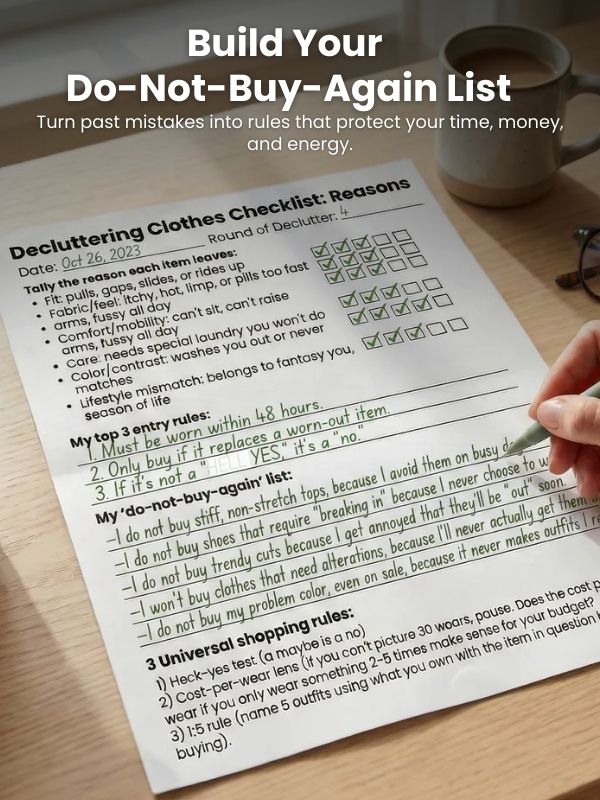
The strongest output of Side 1 isn’t a cleaner closet, though awesome. The strongest output is your rules list. The “do-not-buy-again” list just solidifies your rules. You can skip the section if you don’t think you need to drive the rules home. You’re not punishing yourself; you’re honoring experiments you’ve already run. You’re done lighting money on fire to buy the same headache twice.
Write the sentence: “I do not buy again because I already proved it doesn’t work for me.” Then add rules based on your most-checked categories. For example:
–I do not buy stiff, non-stretch tops, because I avoid them on busy days.
–I do not buy shoes that require “breaking in” because I never choose to wear them.
–I do not buy trendy cuts because I get annoyed that they’ll be “out” soon.
–I won’t buy clothes that need alterations, because I’ll never actually get them altered.
–I do not buy my problem color, even on sale, because it never makes outfits I repeat.
Universal Rules
Here are 3 Universal shopping rules you can add to your Personal list:
1) Heck-yes test (if it’s not an immediate yes, it’s a no),
2) Cost-per-wear lens (if you can’t picture 30 wears, pause)
3) 1:5 rule (name 5 outfits using what you own before buying).
When you’re torn between a practical rule and a tempting exception, use a two-photo poll in Adjust My Crown—real humans vote, you notice how you feel and record it in the Comments below the poll and it’s all automatically saved. If you’re not ready to let something go, create an “On the Fence” Collection in Adjust My Crown, set a wear-by date, and let your calendar make the call, not your guilt.
This is where thrifting and secondhand shine. Once you know your rules, you can scan racks and walk away easily because you’re looking for specific “yes” criteria, not vague “maybe this will fix everything” energy.
How the two-sided printable works
It’s a simple loop: Side 1 captures your “today” reasons and rules, and Side 2 turns those reasons into quick action on Friday.
What’s on Side 1 (today)?
Six reasons with tally boxes, space for your top three entry rules, and a “do-not-buy-again” bullet list. You’re collecting evidence, not opinions.
What’s on Side 2 (Friday)?
A Tailor / Replace / Donate grid to sort fast, plus a spot to jot the reason whenever you donate so it feeds back into Side 1.
What will Friday’s post help you do?
Use the grid for a fast declutter session and handle “On the Fence” pieces without forcing a one-day decision. The point is momentum with less stress.
Why do these two posts work better together?
They help you declutter less often, shop less reactively, and repeat what already works—using photos, your own data, and clear rules instead of perfectionism.
If I do one thing tonight, what should it be?
Print or rewrite Side 1, pick three pieces you’re ready to release, and write down the reason for each. Circle your most common reason—this becomes your first entry rule.
Missed it at the top? No problem! Get the Printable here: Link