

- TL;DR: A smart shopping outfit is a “try-on uniform” that mirrors what you actually wear, so items have to work with your real-life basics (not store lighting or mannequin styling). Build your shopping day outfit from your most-worn pants, throw-on shoes, correct bra, and baseline top, then use a quick pairing test to decide how to shop for clothes without duplicates or regret.
- Do this: Wear your most-worn pants + throw-on shoes (errands-level, not “special occasion”).
- Then: Add your correct everyday bra and your baseline top (the one you repeat most).
- Next: In the fitting room, test every item with your uniform and ask, “What 3 things at home will I wear this with?”
- Stop when: You can name 3 real outfits you’ll repeat (or it’s a no).
How does my shopping day outfit stop dressing room delusion and closet clutter?
Your shopping outfit is about preventing dressing room delusion—that moment when something looks amazing under store lighting with coordinating pieces nearby (instead of things you own), then you get it home and it matches nothing (and you're dressing like a store mannequin which is boring and other people will show up in the same look). The item wasn't wrong. Your testing environment was. So you grabbed all the pieces around the item. Now you look like a walking brand advertisement.
The Try-On Uniform solves this by turning your shopping day outfit into a repeatable formula that represents your actual life. Not your aspirational life. Your real Tuesday morning default. This one shift catches bad purchases before you buy them and eliminates return regret before it starts.
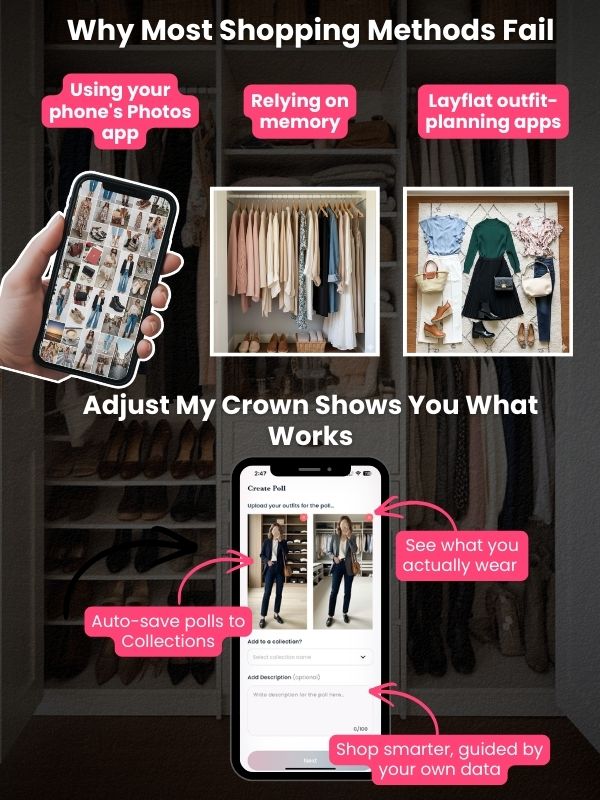
Why Most Records of What You Own Fail When You're Shopping
Using your phone's Photos app: You're hunting through vacation pics and screenshots to find that one photo of your favorite jacket—no organization, no search function, no pattern recognition.
Relying on memory: You forget the four pink sweaters already hanging in your closet and which neutrals you actually reach for versus the ones gathering dust.
Layflat outfit-planning apps: You spend 40 minutes arranging theoretical outfits on your bed instead of learning what you actually wear—they don't capture real body feedback or show which combinations you repeat.
Adjust My Crown is different because it captures real wear data. When you post side-by-side polls, those outfits auto-save to Collections. Over time, you build a searchable archive of your true style defaults, on your own body which shows your proportions, which is exactly the data you need when shopping for clothes.
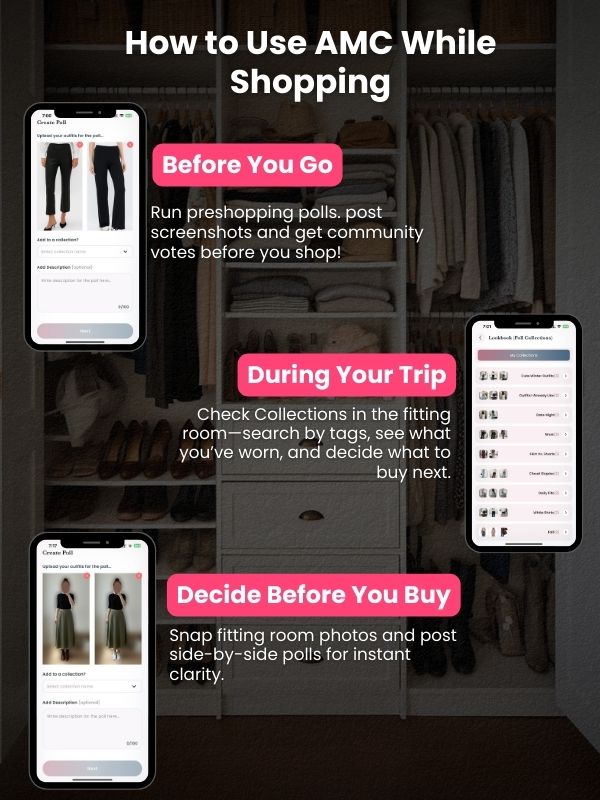
How to Use AMC While Shopping
Before you go: Collections show you what you never wear, which prevents repeat mistakes. If you own five pairs of black pants but only one appears in Collections, stop buying black pants. You can also run preshopping polls on items you're considering—post screenshots and let your community vote before you drive to the mall.
During your trip: Scroll through Collections while standing in the fitting room. Search for "pink" or "cold weather" if you tagged your polls. Trying on another pink sweater? Check how many you already own and actually wore. Maybe that justifies it, or maybe you should buy the olive green option that matches the scarf you wear constantly.
Take fitting room photos and post real-time polls if you want opinions. The side-by-side format forces clarity: "New skirt with my daily sneakers vs. new skirt with boots I never wear."
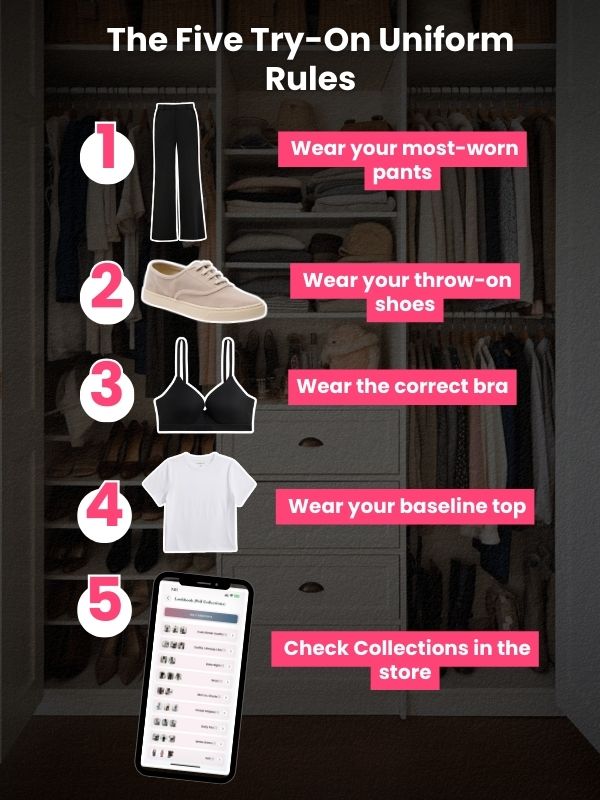
The Five Try-On Uniform Rules
1. Wear your most-worn pants—not your favorite, the ones you grab three times a week. Check Collections to confirm.
2. Wear your throw-on shoes—the ones for errands and pickup, not the heels that never appear in your saved outfits.
3. Wear the correct bra—if the new item requires a strapless bra you don't own, that's a $60 add-on cost.
4. Wear your baseline top—the white tee, fitted tank, blue button down, black sweater that appears in Collections most often.
5. Check Collections in the store—before you buy, ask: Do I already own this? Do I wear items like this? What will I pair this with at home?
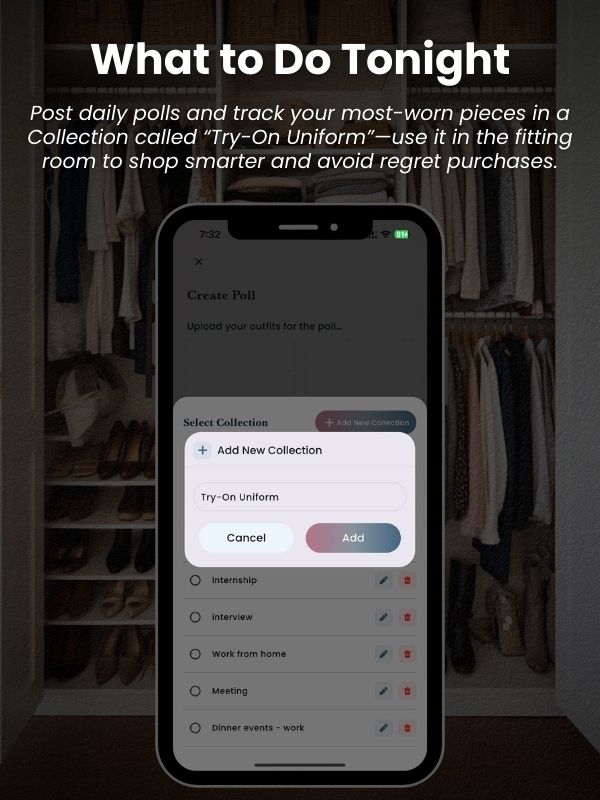
What to Do Tonight
Open Adjust My Crown and scroll through Collections. Write down the three items that repeat most often. That's your Try-On Uniform. If you don't have enough data yet, start posting daily polls this week—even for outfits you're sure about. You're building evidence that prevents regret purchases later. Save it in a Collection called "Try-on Uniform".
Next time you go shopping, wear that uniform and open Collections in the fitting room. If something looks good with your real defaults and doesn't duplicate what you already wear, and you love it, it's a heck yes. If it only works with items you never reach for, it's a no. The dressing room mirror can lie, but your Collections data doesn't.
What should I wear shopping if I’m buying tops?
Wear your most-worn pants, your everyday bra, and your default shoes so tops are forced to work with your real proportions and daily styling.
How do I avoid “dressing room delusion” under store lighting?
Stop styling items with the store’s perfect add-ons. Use your try-on uniform and only say yes if it works with your real-life basics in a fast 3-outfit test.
What’s the fastest rule to stop closet duplicates while shopping?
Check what you already repeat (your saved outfits/Collections), then don’t buy another version unless it clearly replaces a worn-out workhorse or fills a proven gap.
Should I take fitting room photos when I shop?
Yes, if you use them for decision-making (not perfection). Take two quick comparison photos and either run a poll or compare “with my daily shoes” vs. “with fantasy shoes.”
How do I know when something is a “heck yes”?
If it works with your uniform, you can name three repeatable outfits, and it doesn’t duplicate what you already wear, it’s a yes. If it needs extra purchases or special styling, it’s a no.