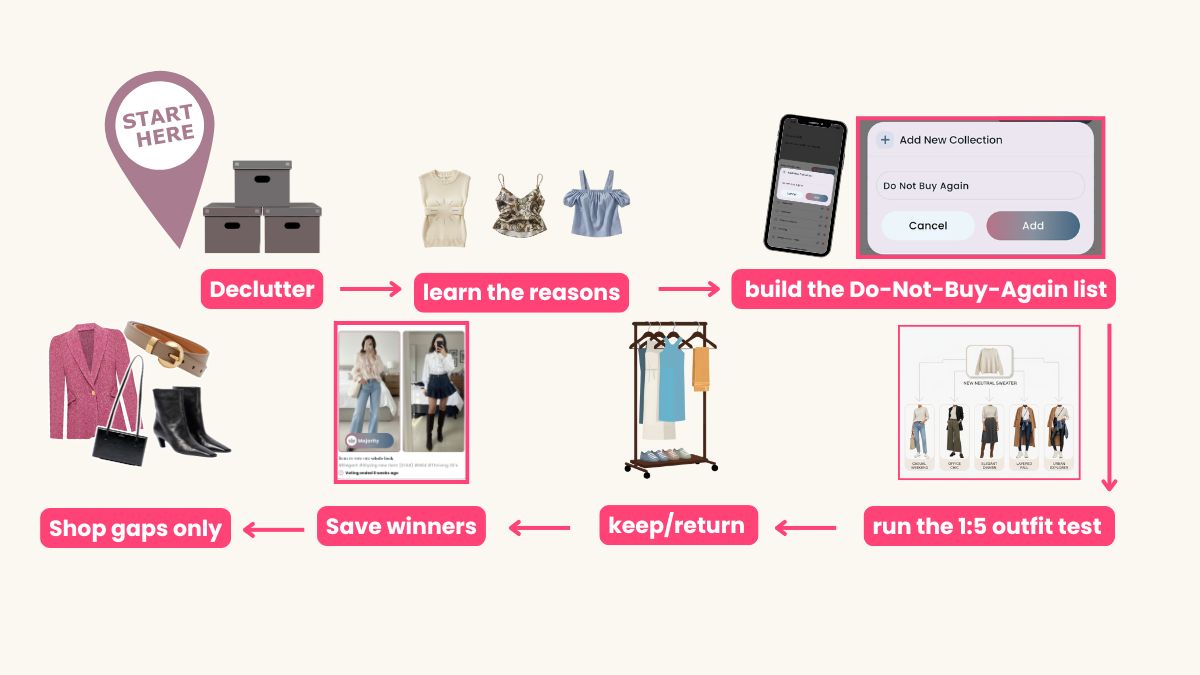
- Declutter pile = data: Fit, lifestyle mismatch, or duplicates → turn each into a shopping rule.
- Do-Not-Buy-Again list: If you declutter it more than once, stop re-buying it.
- The 1:5 Rule: One new item must make five real outfits with what you already own.
- Shop gaps only: Buy what completes outfits—not random “cute.”
How to Shop for Clothes Without Adding Closet Clutter
Let’s be honest: you can do a closet cleanout, feel amazing, and still end up right back where you started. Not because you “failed.” Not because you’re messy. Not because you need to Marie Kondo harder. It’s because decluttering is maintenance… and shopping is the source of the future clutter.
If you want to stop the clutter from coming back, you don’t need another cleanout. You need closet entry rules—a way to decide what gets to come home with you in the first place.
This post is my favorite way to do that: a simple system for how to shop for clothes without turning your closet into a revolving door for shopping/clutter.
Why closets get cluttered again (even after decluttering)
Here’s what usually happens: You declutter. You donate. You make piles. You swear you’re “only buying basics” from now on. You feel like a brand-new person. Then you go into Target (or scroll your favorite site) and suddenly you’re holding a “cute little top” that seems harmless because it’s only $24 and it’s “so versatile.” Or maybe you big splurge on a top your favorite Influencer had on and looked so chic in and it's dry clean only and you'd never actually wear it in your real life.
Fast-forward: it gets worn once (maybe), then it becomes one of those pieces you’re always moving around but never choosing. So the clutter returns. And it builds. And the problem isn’t that you didn’t declutter hard enough. The problem is that your closet has no “entry policy”. Think of it like this: decluttering is taking out the trash. But your shopping habits are the open front door. If the door stays open, stuff will keep walking in.

Step 1: Use your declutter pile as data
Your declutter pile isn’t “stuff you don’t want.” It’s your closet giving you receipts. Most things get purged for three reasons—turn each into a rule:
–Fit problems: pinches, rides up, needs “the right bra,” you tug all day.
Rule: “I don’t buy this unless it fits perfectly right now.” No tailoring dreams. No “it’ll stretch.”
–Lifestyle mismatch: cute in theory, wrong for real life (hello, dry clean only / heels / fussy pieces).
Rule: “I don’t buy items for my fantasy life.”
–Duplicates: “another version” you never wear because you already have a favorite.
Rule: “I don’t buy duplicates unless it replaces something worn out.”
That’s how decluttering clothes becomes data, not guilt.
Step 2: Build a “Do-Not-Buy-Again” list
This is your shopping guardrail against things you keep buying… and keep decluttering.
Examples: scratchy sweaters, fussy shoes, trendy tops you avoid, “almost perfect” jeans, dry-clean-only anything, fantasy-life purchases. If you declutter a category more than once, it goes on the list. No debate. Stop re-buying what your closet has already rejected. You have to be brutally honest about (and grateful for) your lifestyle if you want to truly wear the clothes in your closet.
Step 3: The 1:5 Rule (One New, Five Old)
This is the rule that prevents clutter before it happens.
Before you keep anything new, you have to style it five ways using what you already own.
One new piece must create five real outfits. Not five fantasy fits. Not five “it could work if I had…” situations. Five outfits you would actually wear in your real life. If you can’t make it work with your current closet, what you’re buying isn’t an outfit-maker. It’s a future item to declutter.
How to practically do this, because styling clothes isn’t easy!
The STAR method is your easy way of doing this: Scan the new piece against your entire closet. Take out everything that could work. Arrange into outfits. Remember with pictures (Your 7am brain shouldn’t have to work so hard on things that are easily remembered.)


Step 4: Turn this into a 10-minute preshopping routine (AMC version)
Here’s the part that makes this system stick.
Because the hardest part isn’t understanding the rule. The hardest part is remembering it when you’re tired, rushed, and standing in fitting-room lighting that has never done anyone a favor.
So you make the rules visible and easy.
This is where Adjust My Crown becomes your shopping safety system.
Your 2-minute preshopping routine:
–Create a Collection called “Do Not Buy Again" and move outfits with those pieces into that Collection.
–Create a Collection called “Need More to Match With.” Add outfits where there’s one piece you want to wear more, but you don’t have enough other items to pair it with yet.
Step 5: Shop for gaps that you've realized by being more analytic
Common “gap fillers” that quietly fix a wardrobe:
–a neutral belt (structure is an outfit-maker)
–a true third piece (blazer, cardigan, denim jacket)
–a shoe lane upgrade (white sneakers + loafers, or ballet flats + tall boots cover so much life)
–a structured bag (instant polish)
And sometimes the best “gap” isn’t a clothing item at all—it’s a closet tool that makes your wardrobe easier to see outfits in, like Adjust My Crown.
Because the goal isn’t “own more.” The goal is wear more of what you already own and feel fantastic in it.
The Preshop Filter (the whole system in one line)
If you want the whole thing as a simple mental checklist, here it is:
Declutter → learn the reasons → build the Do-Not-Buy-Again list → run the 1:5 outfit test → keep/return → save winners → shop gaps only
That’s it. That’s the shopping safety system.
And it works because it treats your closet like a real ecosystem, not a mood board for a fantasy lifestyle.
Tiny reminder you can add to your life (and your cleanout posts)
Before you buy anything new:
–Check your Do-Not-Buy-Again list
–Check your “need more to match with” Collection
–Run the 1:5 test
–Shop gaps only
You’ll buy fewer things, wear more outfits, and your closet will stop re-cluttering itself.

FAQ: Shopping Without Closet Clutter
What is the 1:5 rule?
The 1:5 rule means: before you keep one new item, you must be able to style it into five real outfits using what you already own. If you can’t, it’s likely future clutter.
How do I shop my own closet first?
Start by reviewing what you actually wear (photos help). Then test any “new” idea against your current wardrobe: can you make outfits with what you already have? This is the fastest way to shop your own closet and avoid duplicates.
What goes on a Do-Not-Buy-Again list?
Anything you repeatedly buy and repeatedly declutter—scratchy sweaters, fussy shoes, trendy tops you avoid, “almost perfect” jeans, and fantasy-life items. If you declutter it more than once, add it.
How do I stop buying duplicates?
Make a simple rule: you don’t buy duplicates unless you’re replacing a worn-out favorite. If you already own a version you love, the “almost the same” item is usually clutter.
What if I can’t style the item 5 ways?
That’s the point of the test. If it can’t make outfits with your current closet, it’s not an outfit-maker—it’s a “buy the rest later” trap. Put it on hold or return it.
What should I shop for instead?
Shop for gaps that survive the test—often basics or “third pieces” that complete outfits: a neutral belt, a blazer/cardigan/denim jacket, a shoe-lane upgrade, or a structured bag. Sometimes the best “gap” is a closet tool that helps you see outfits.
How do I use Adjust My Crown for preshopping?
Create two Collections: Do Not Buy Again (notes/screenshots of what you declutter + why) and Need More to Match With (outfits where one piece needs better pairings). When you’re torn, post a two-photo poll and save the winner.