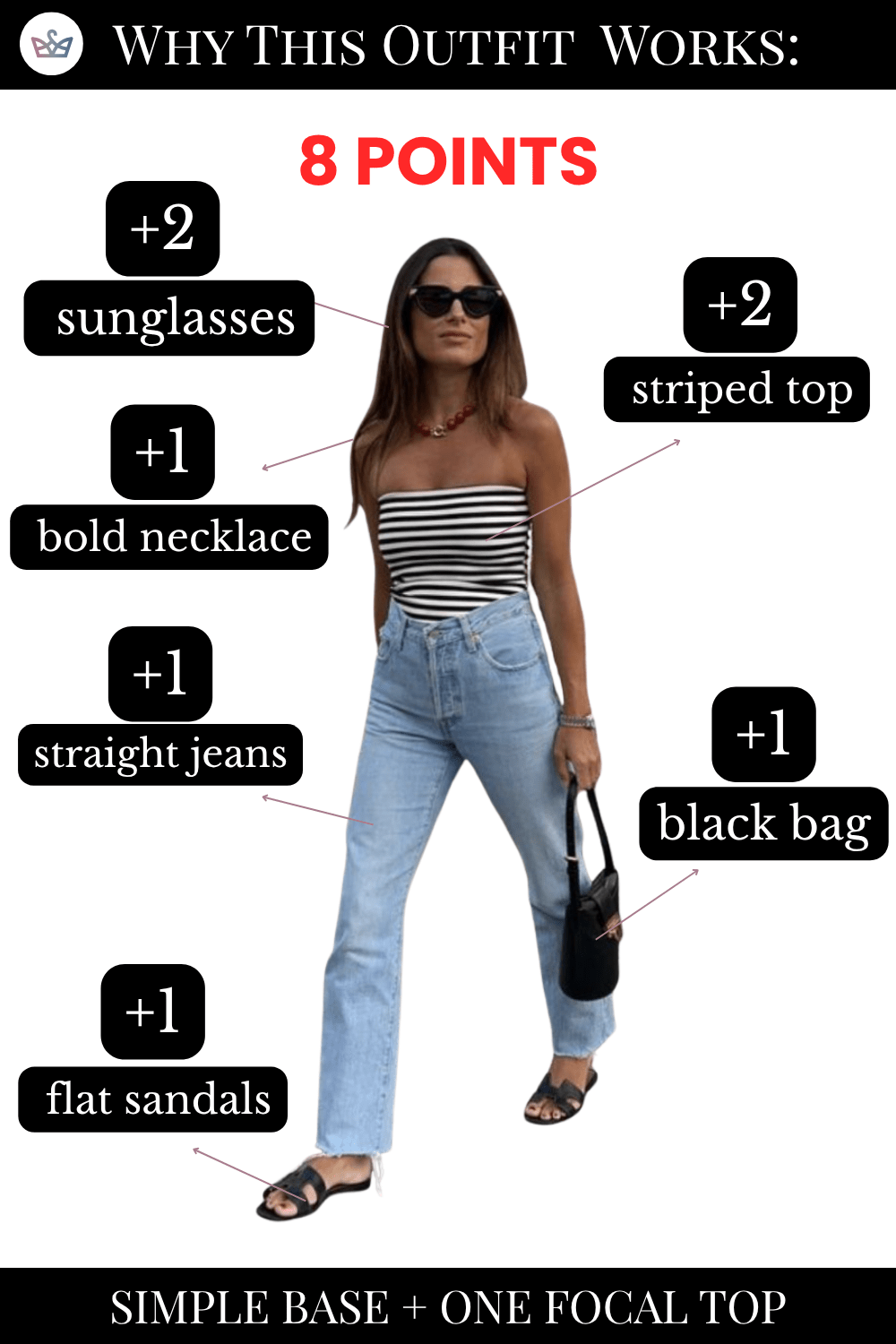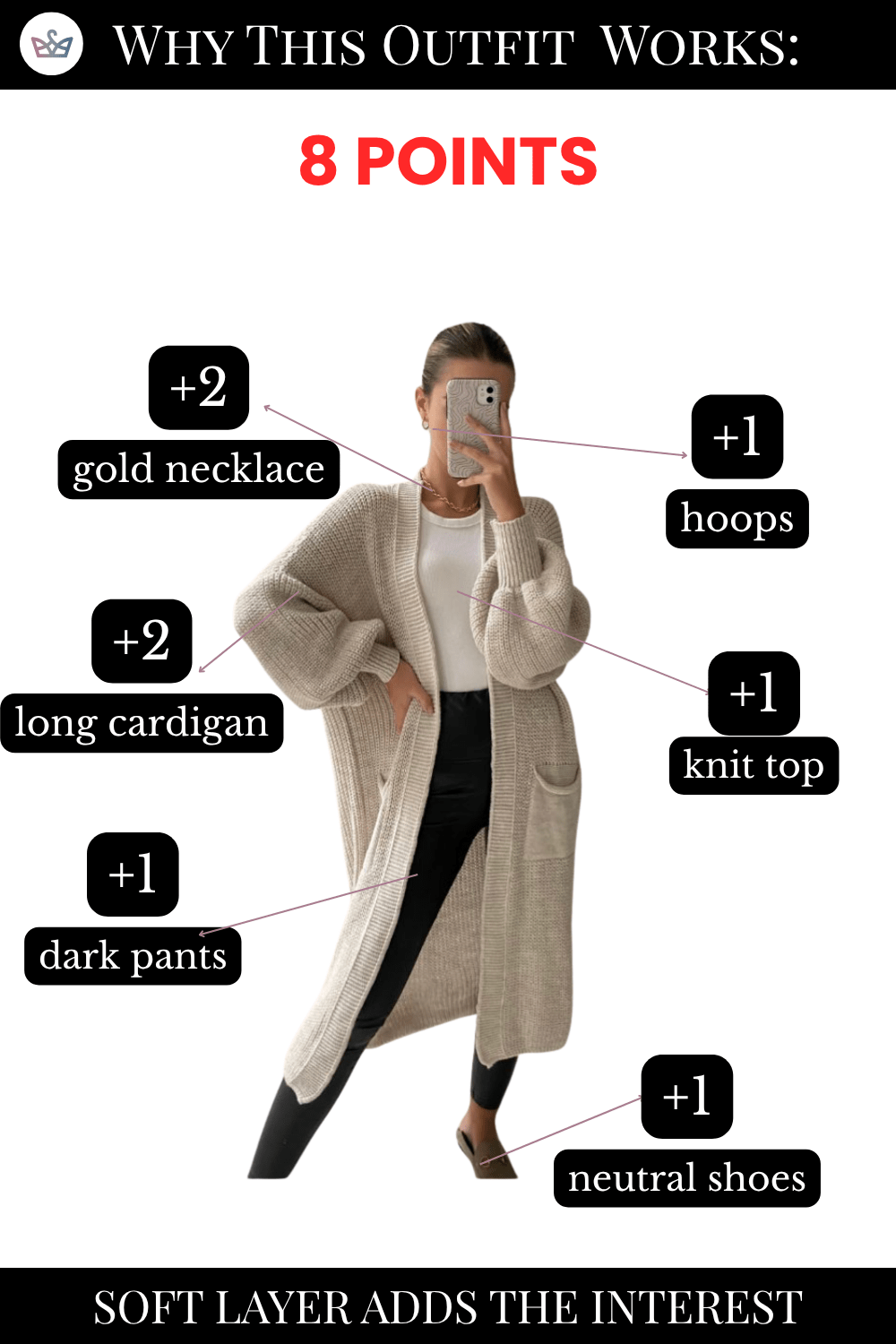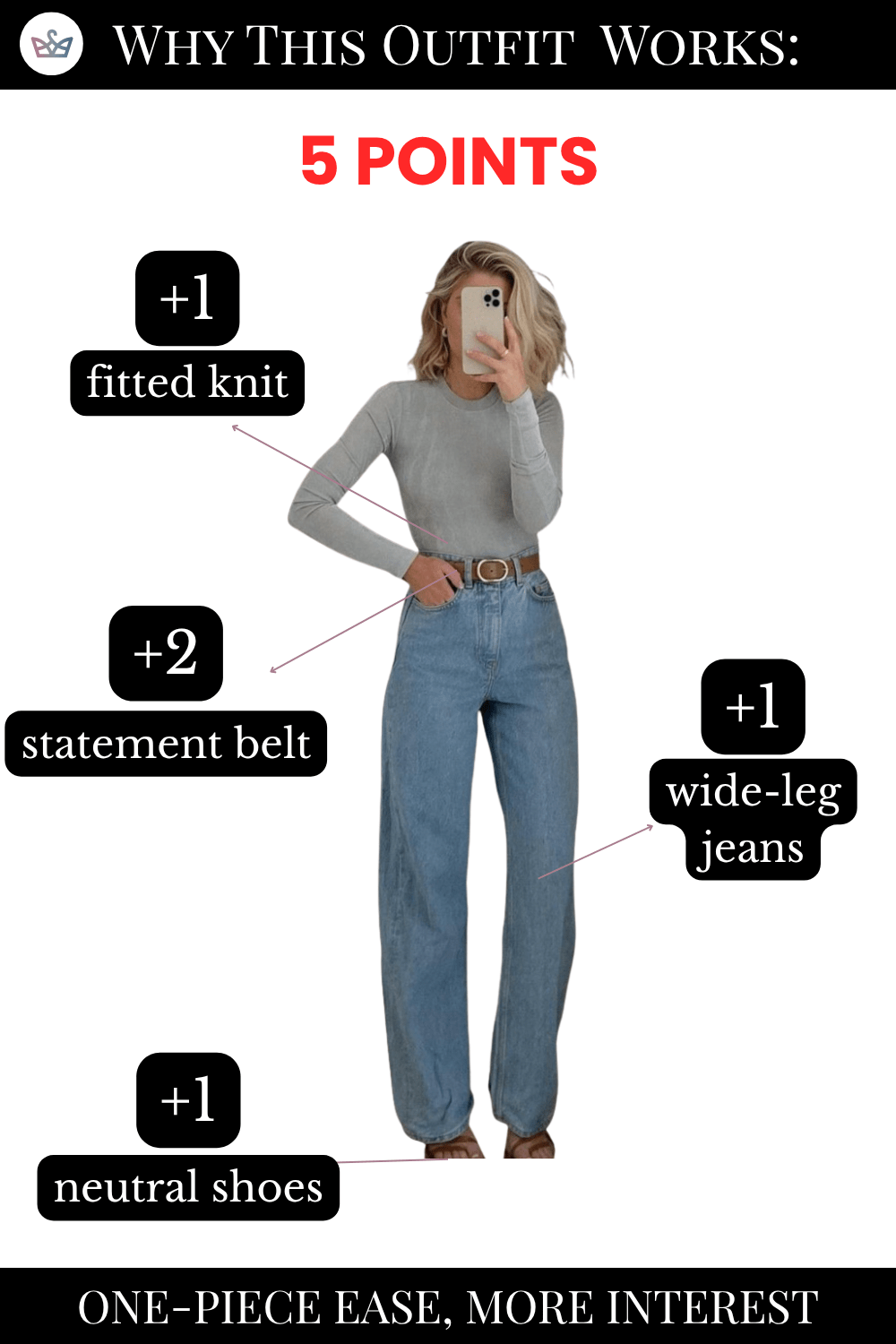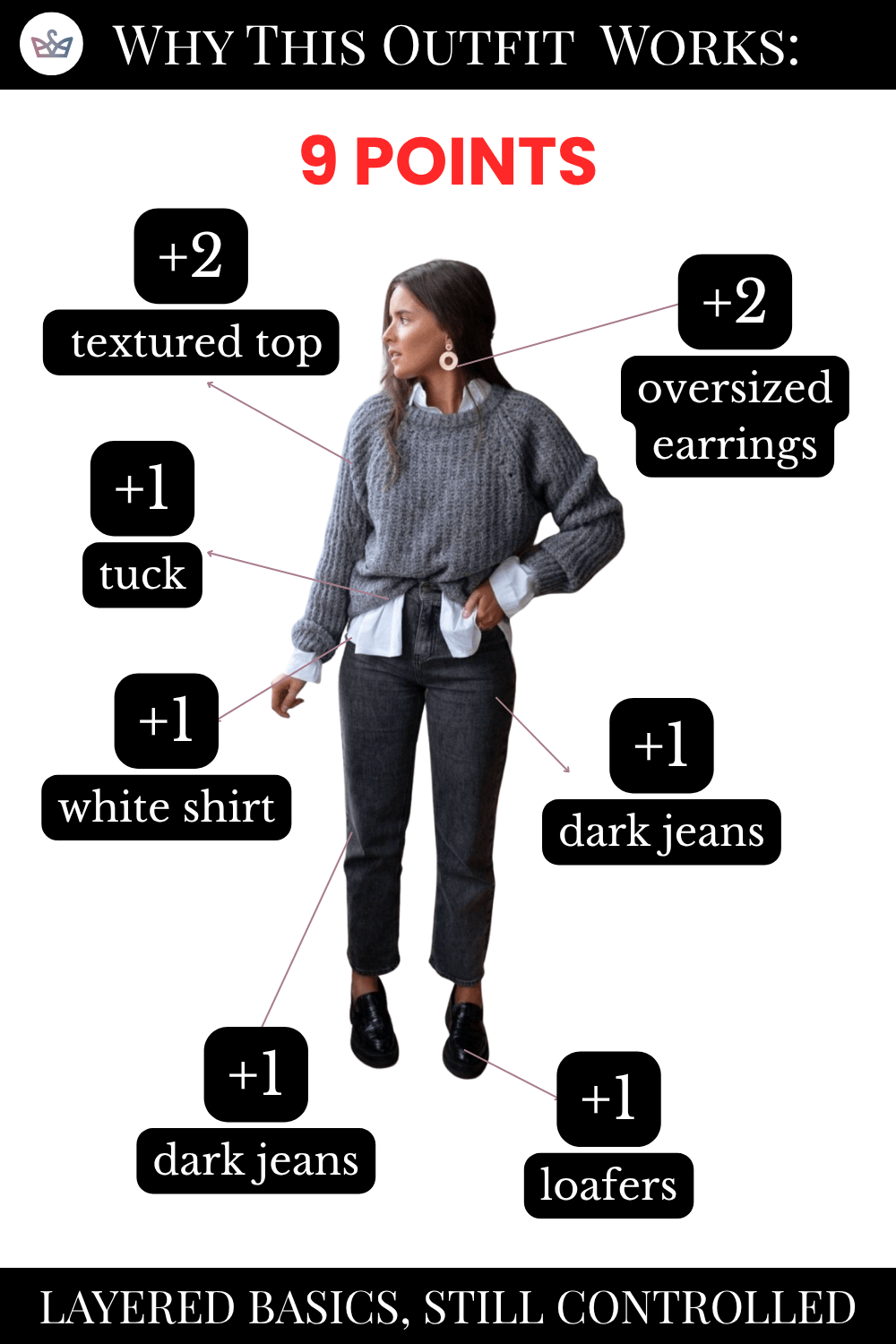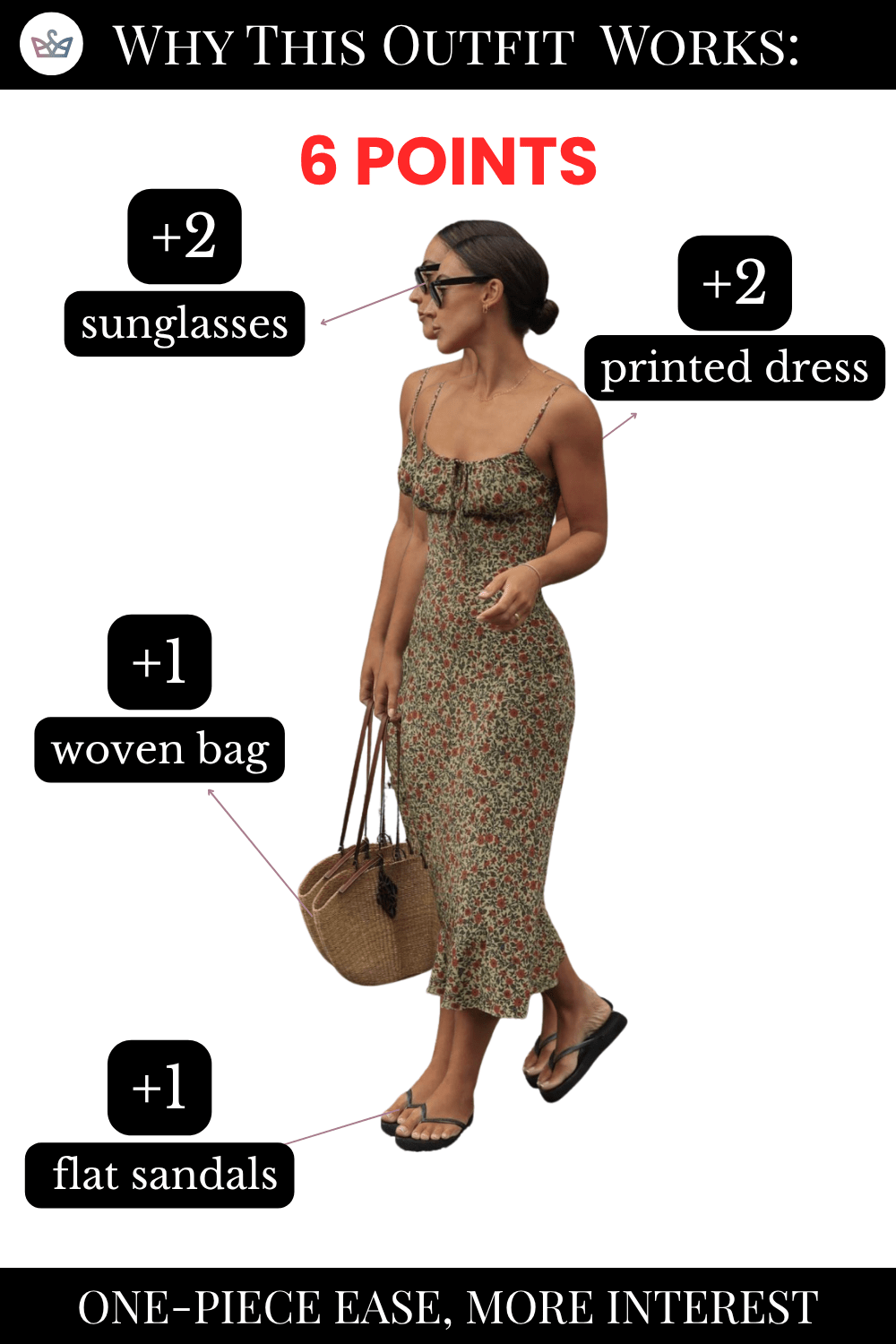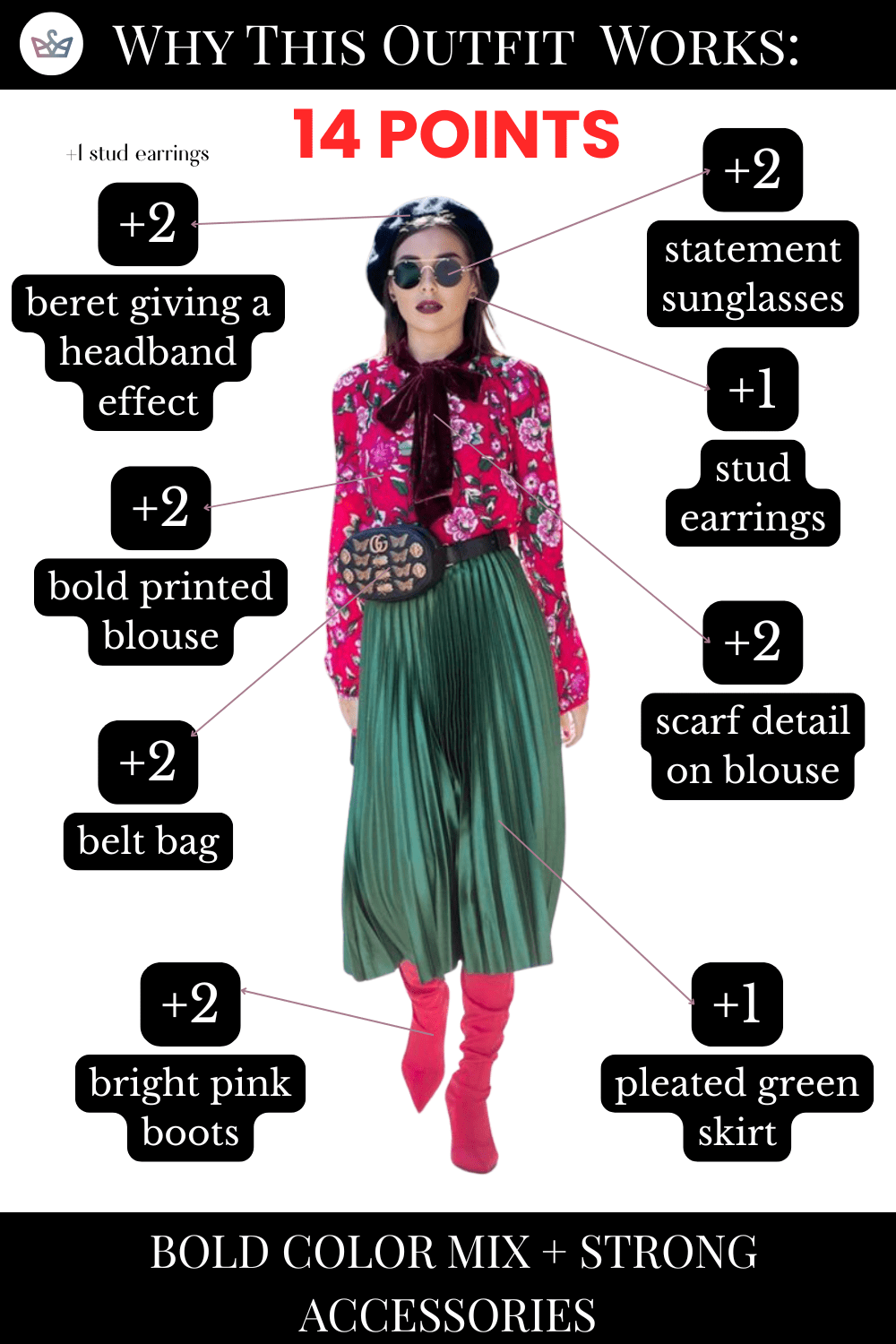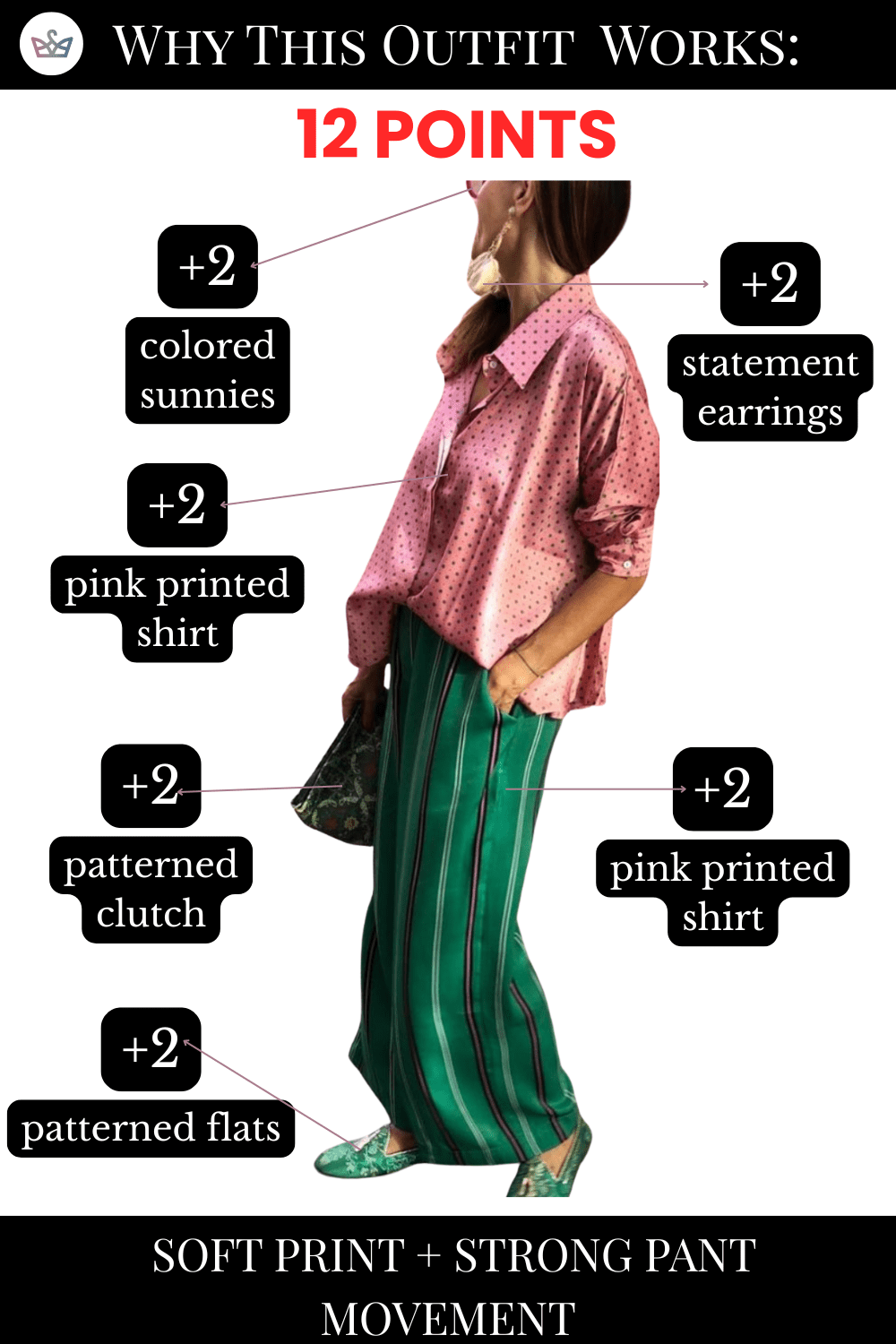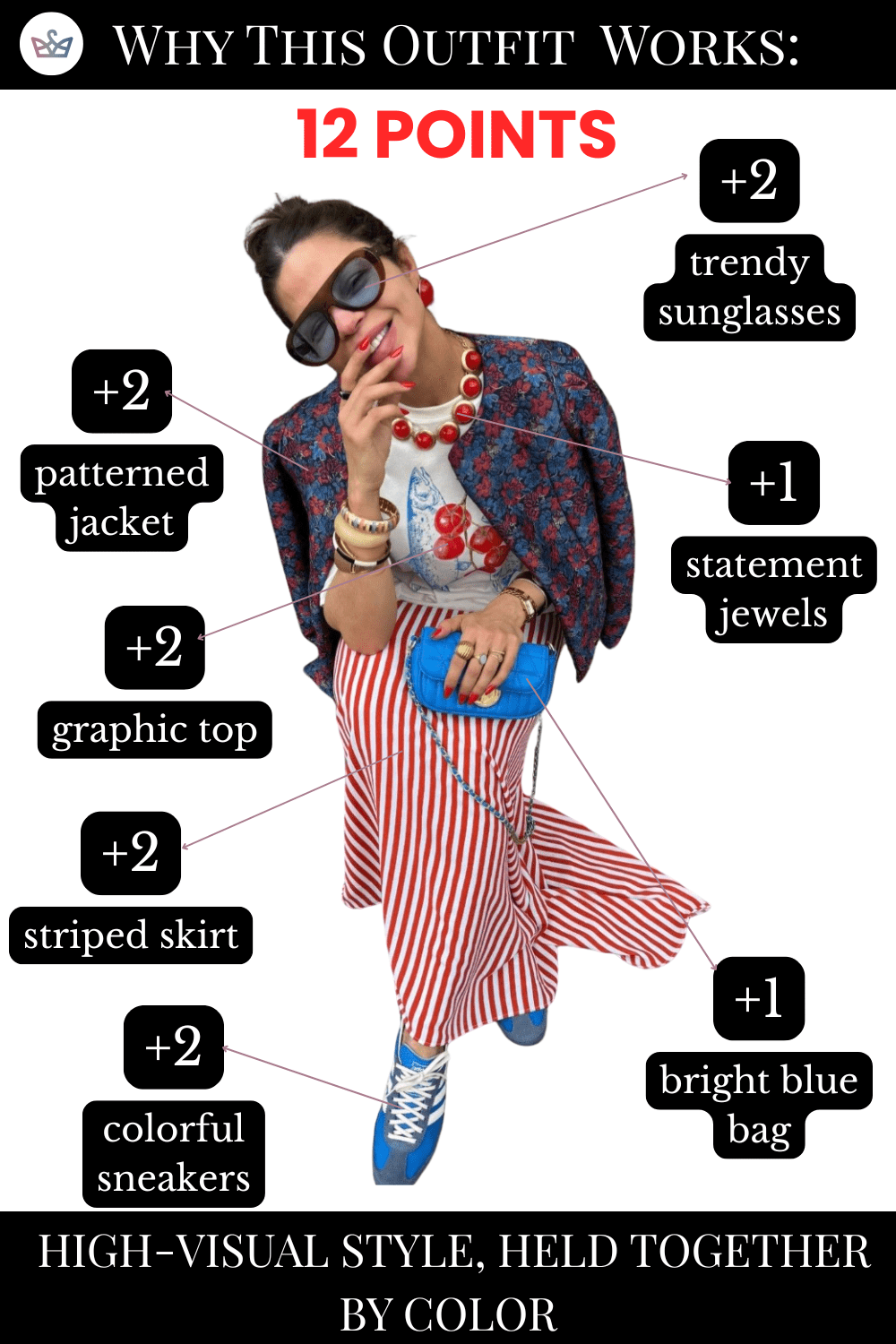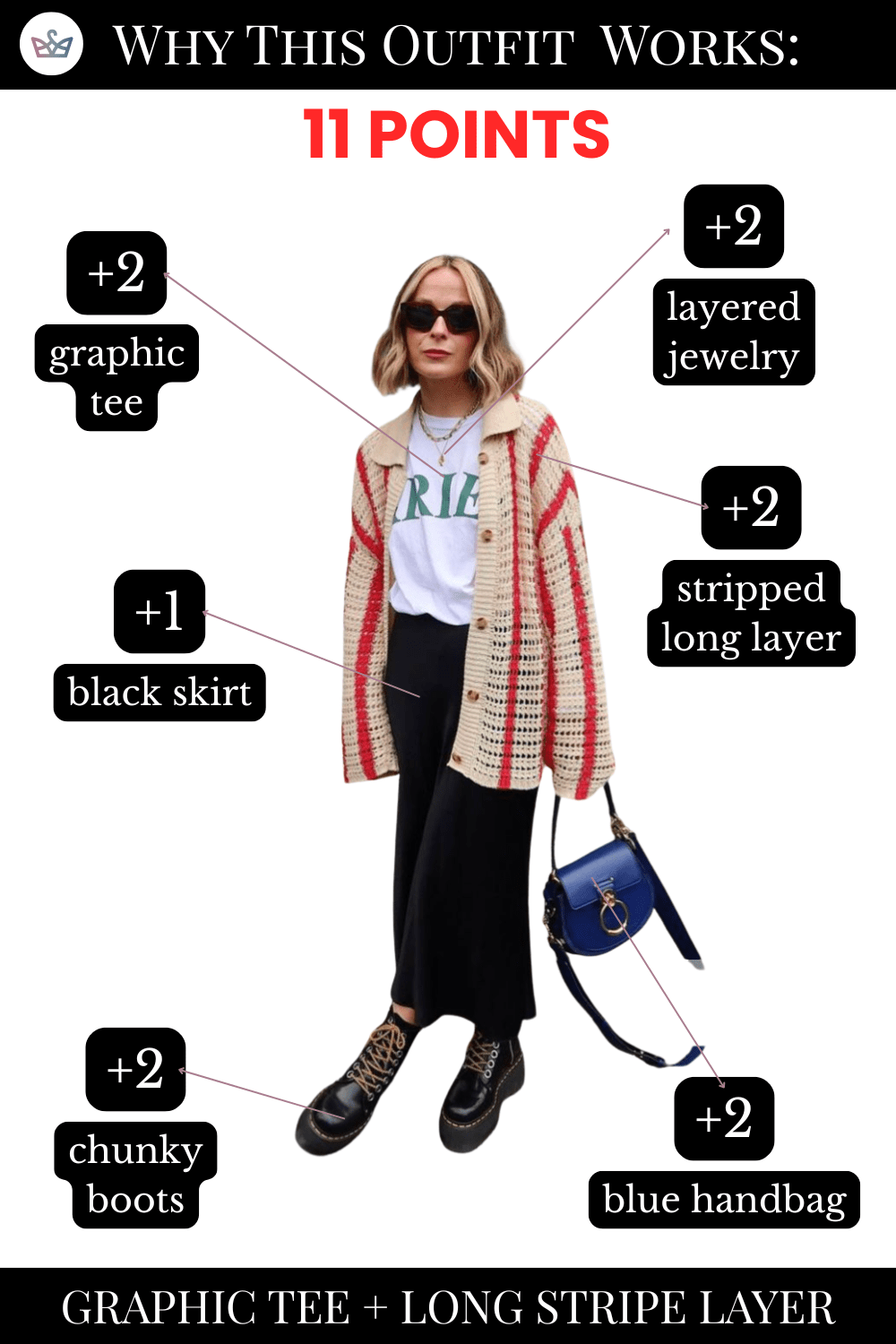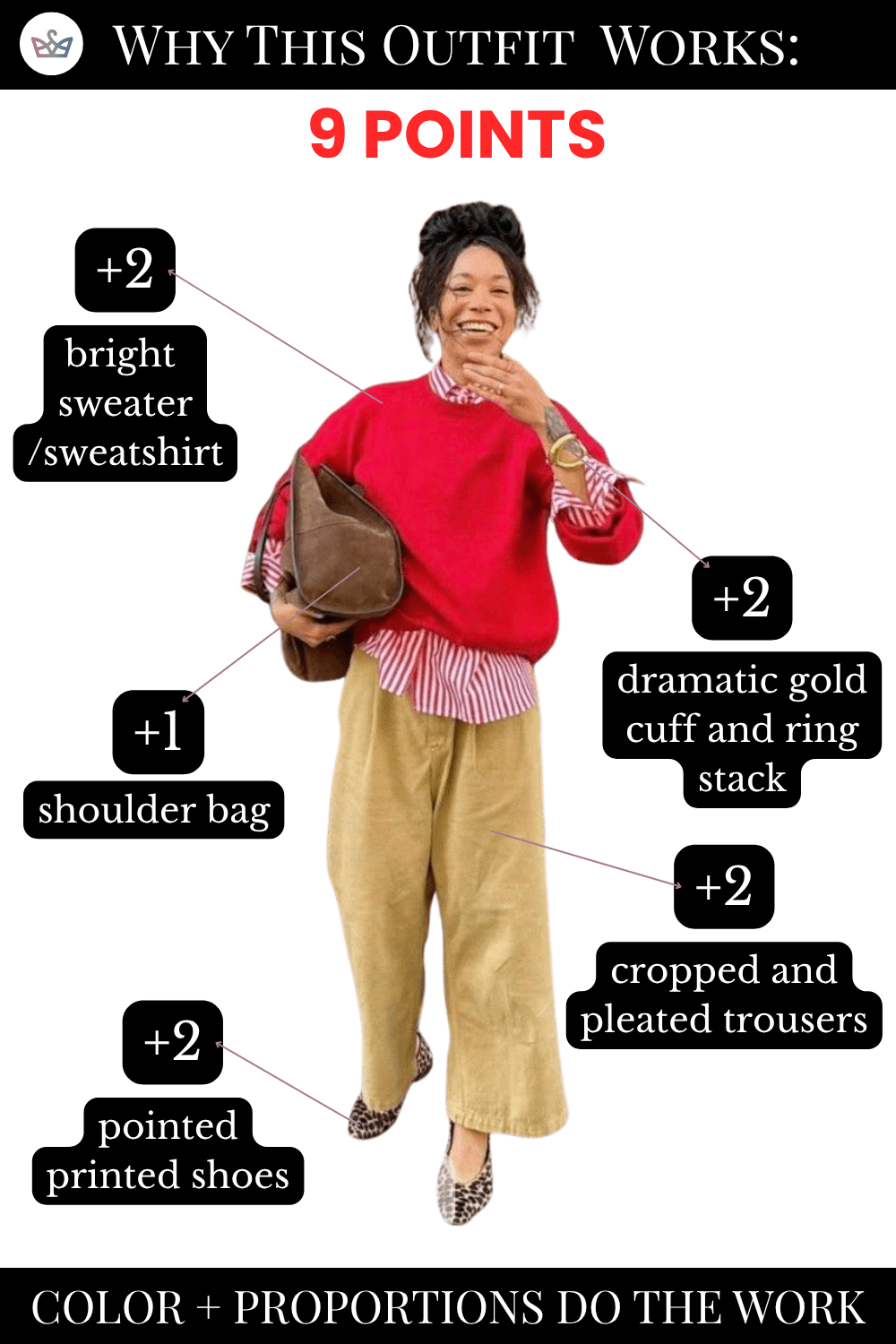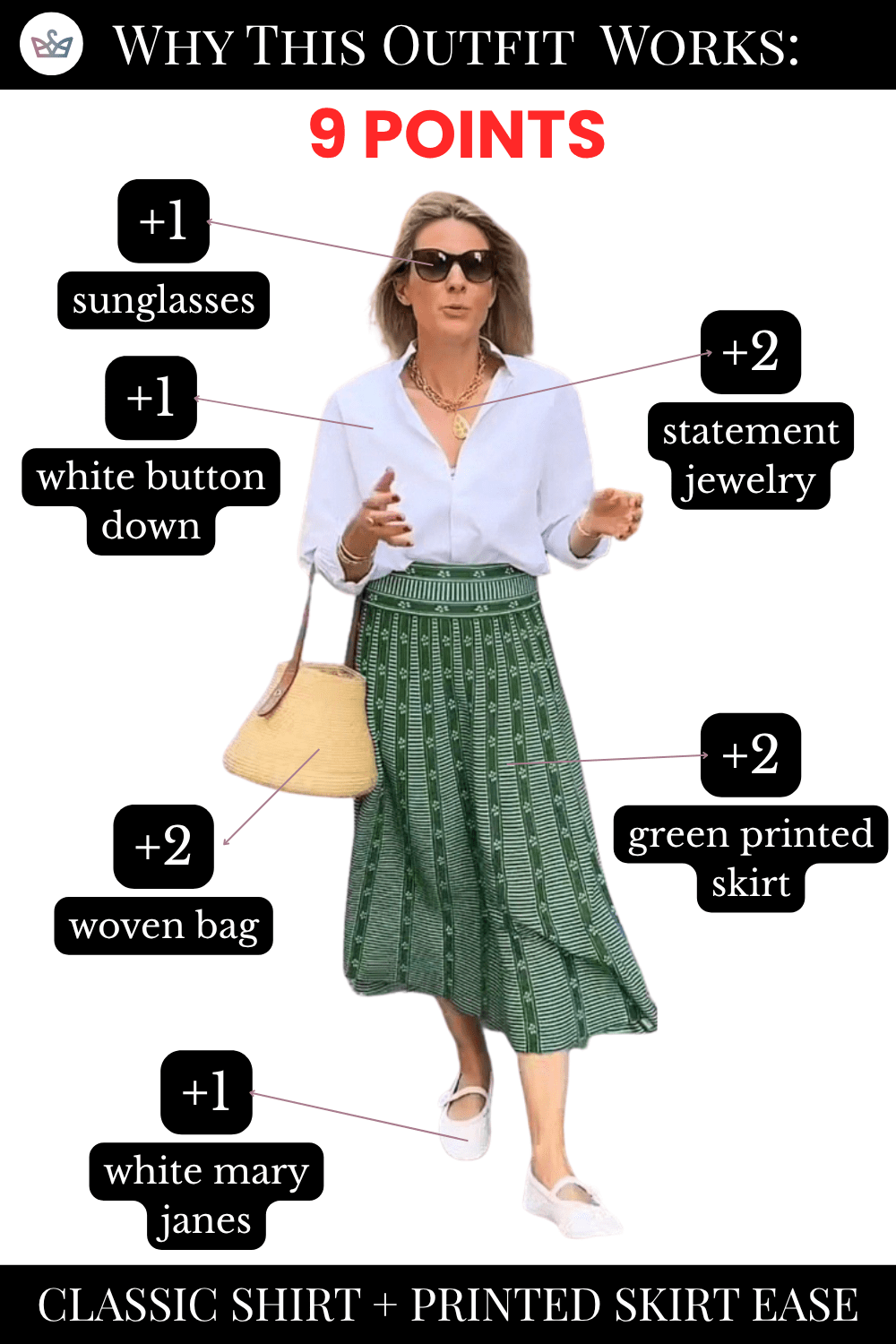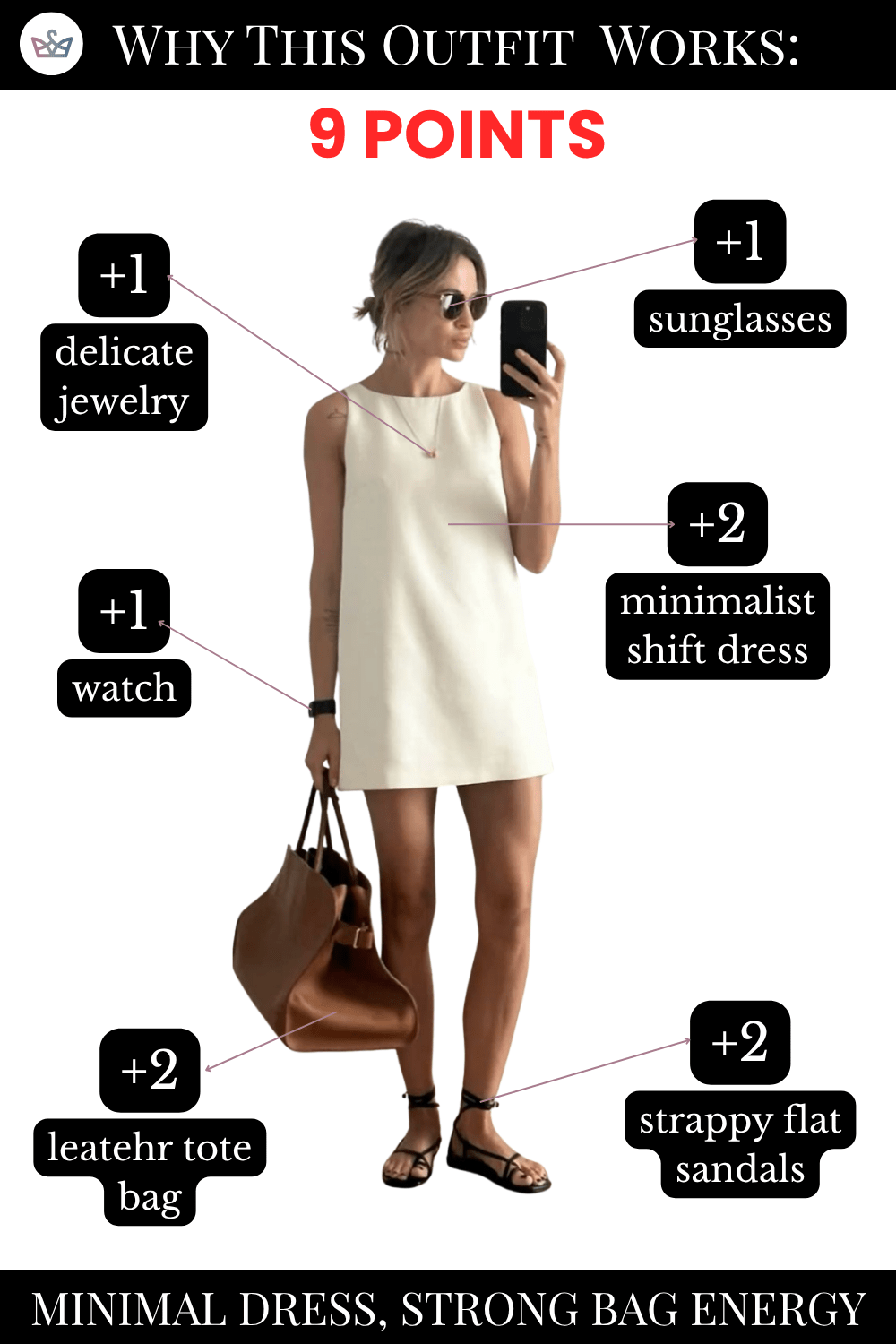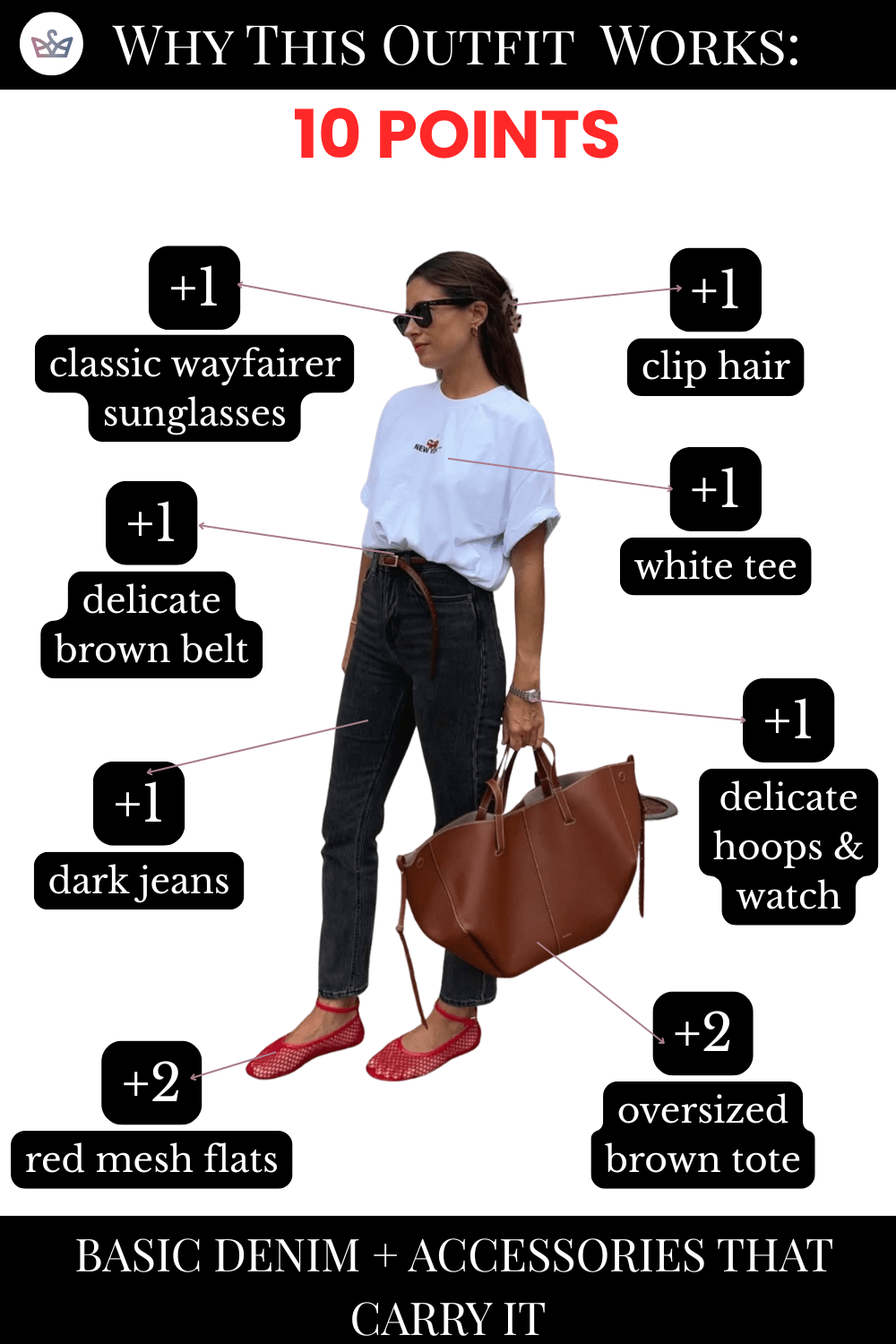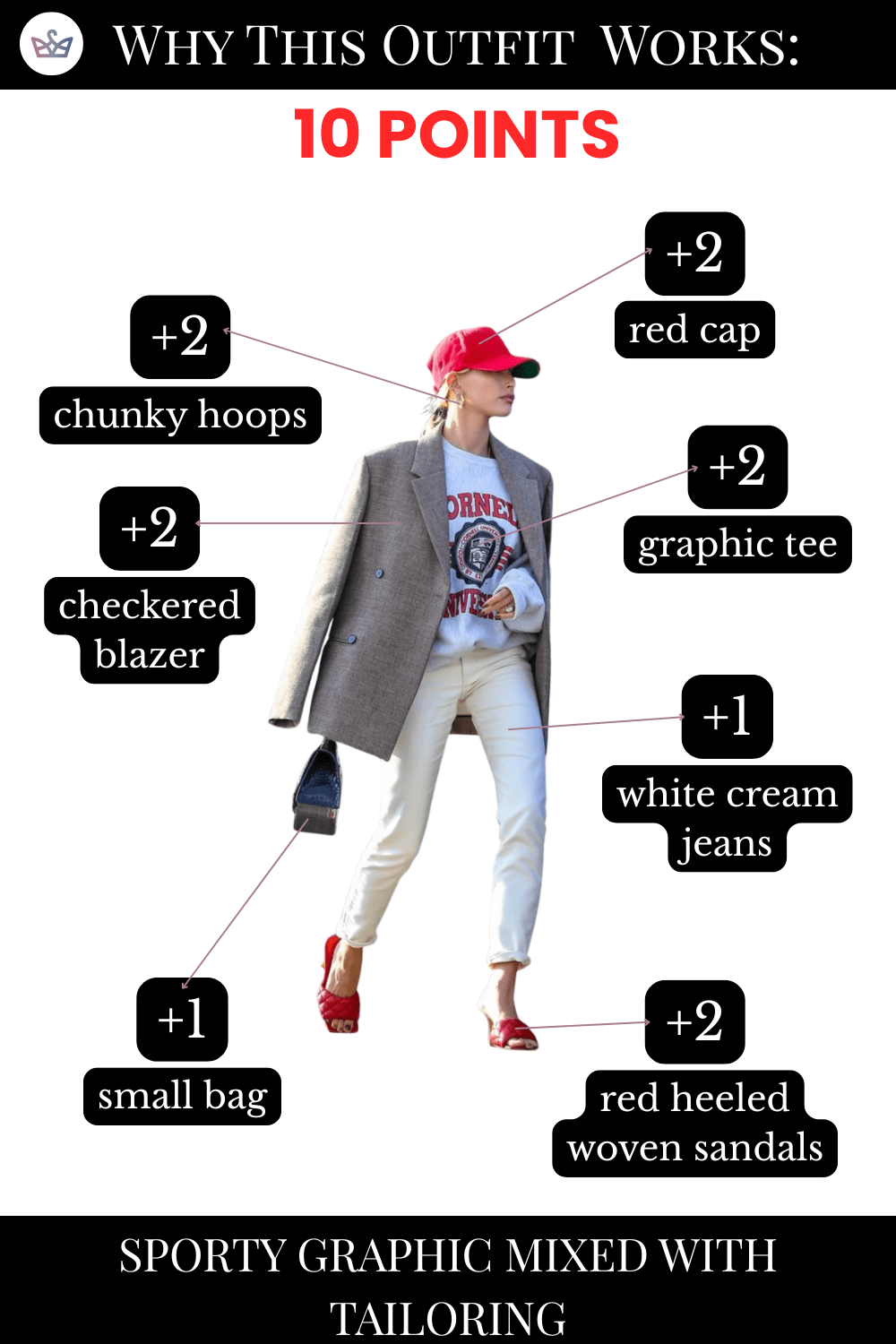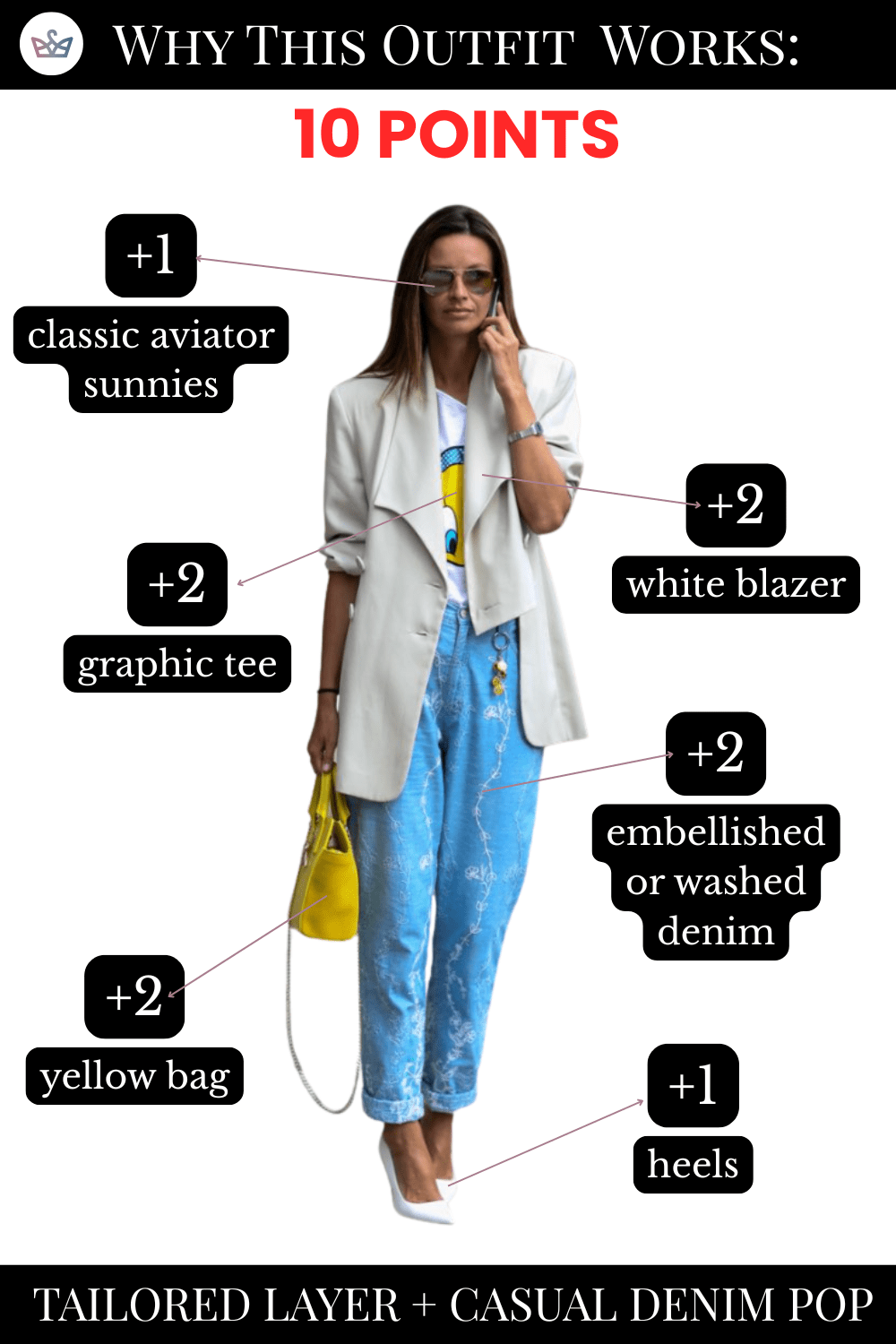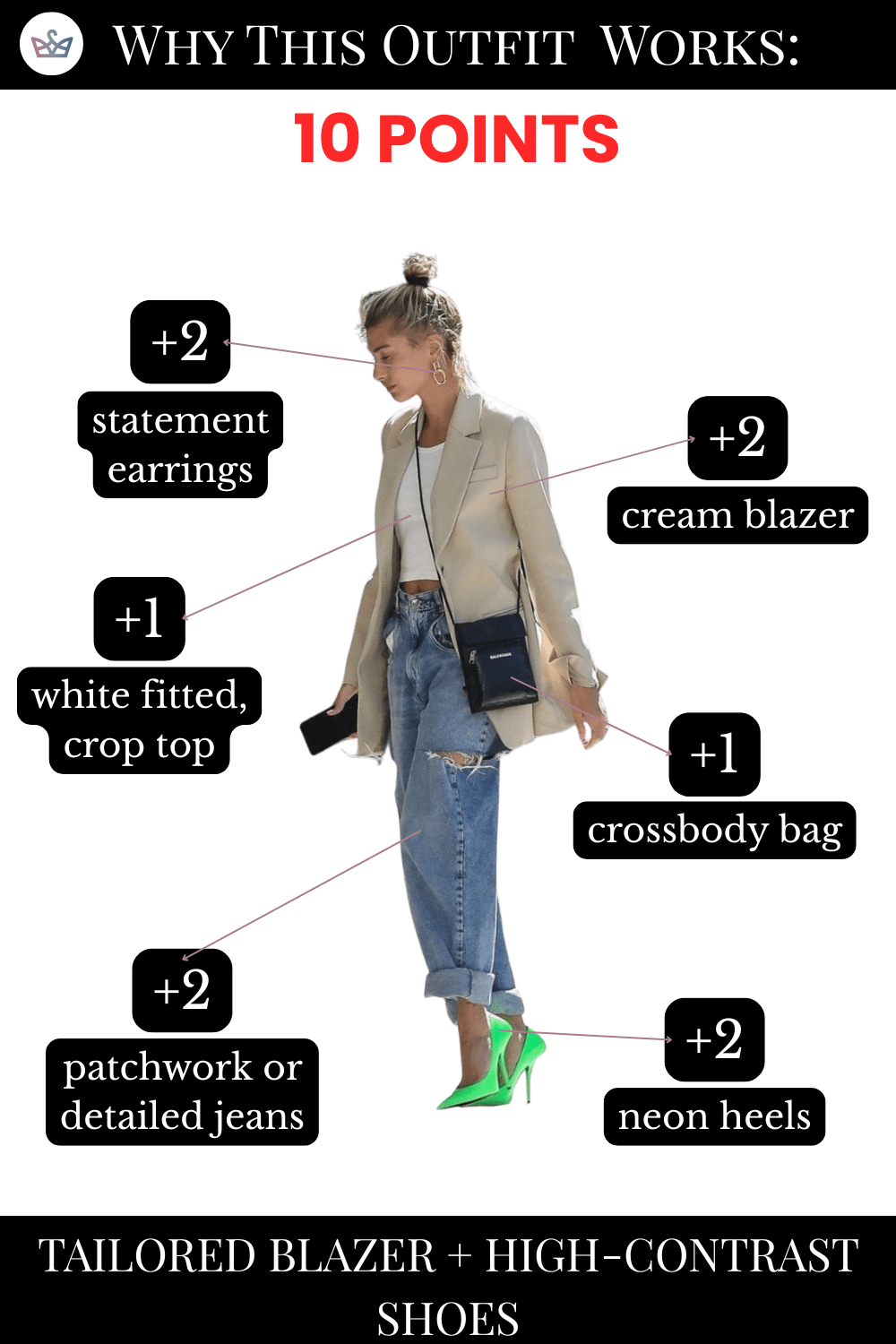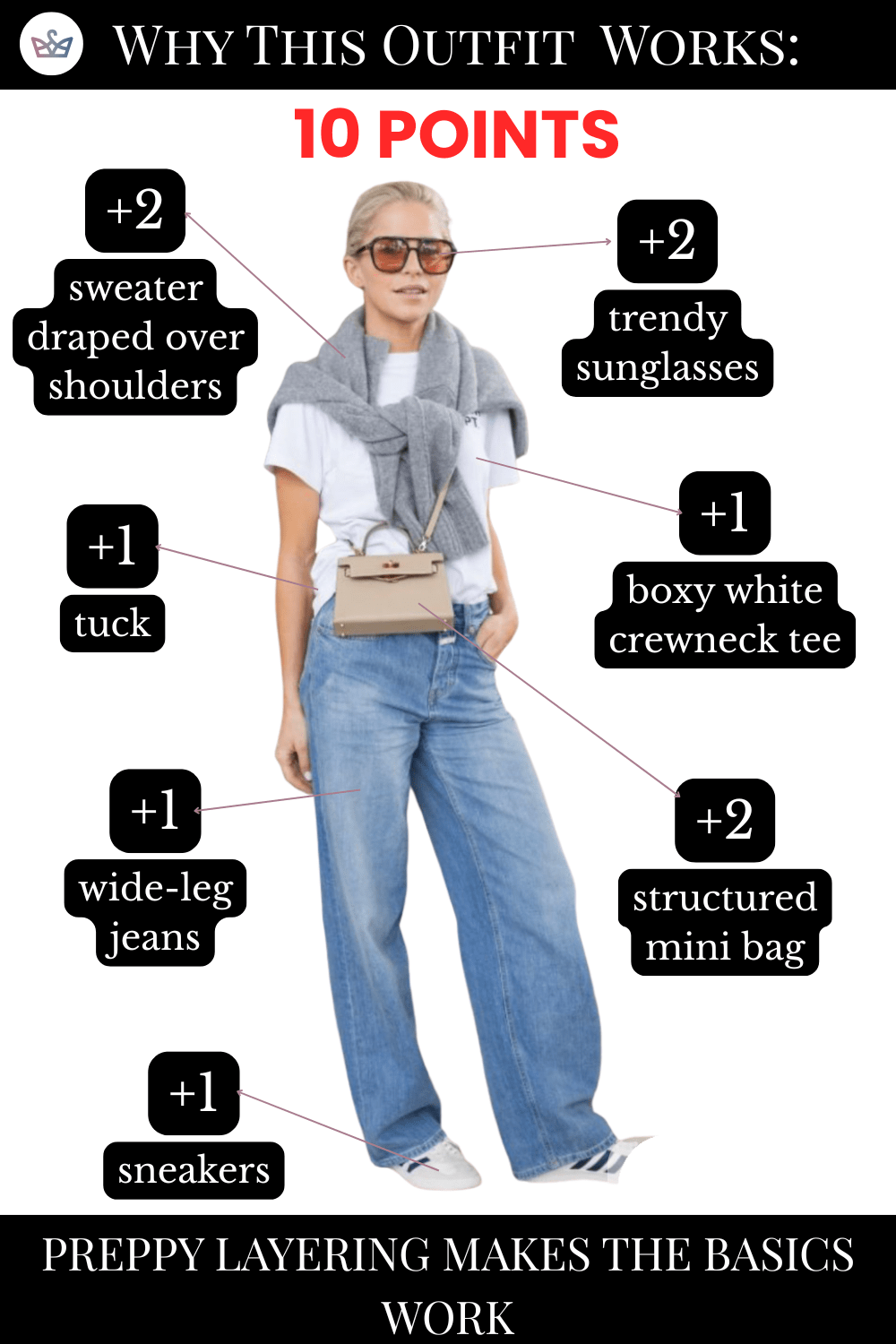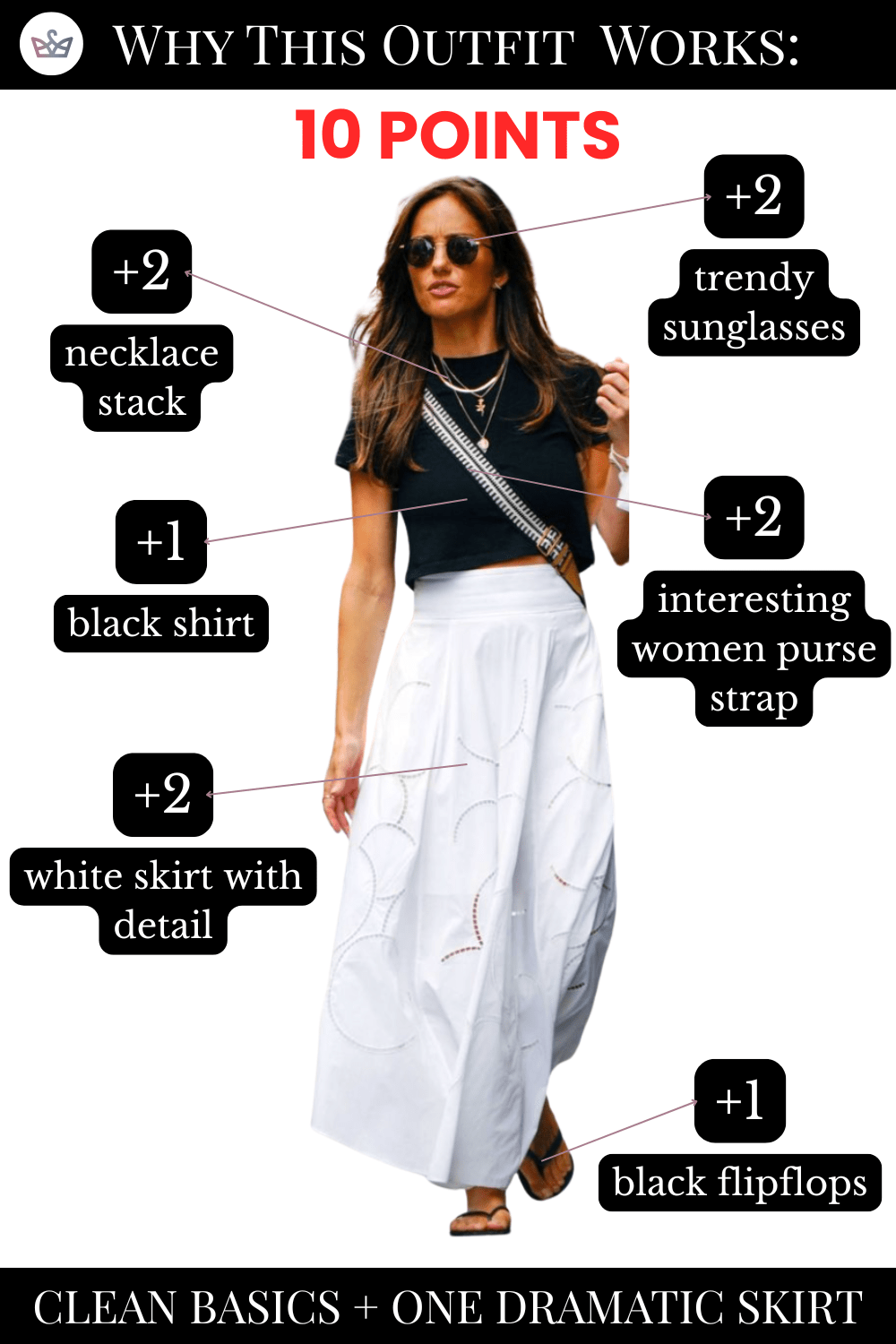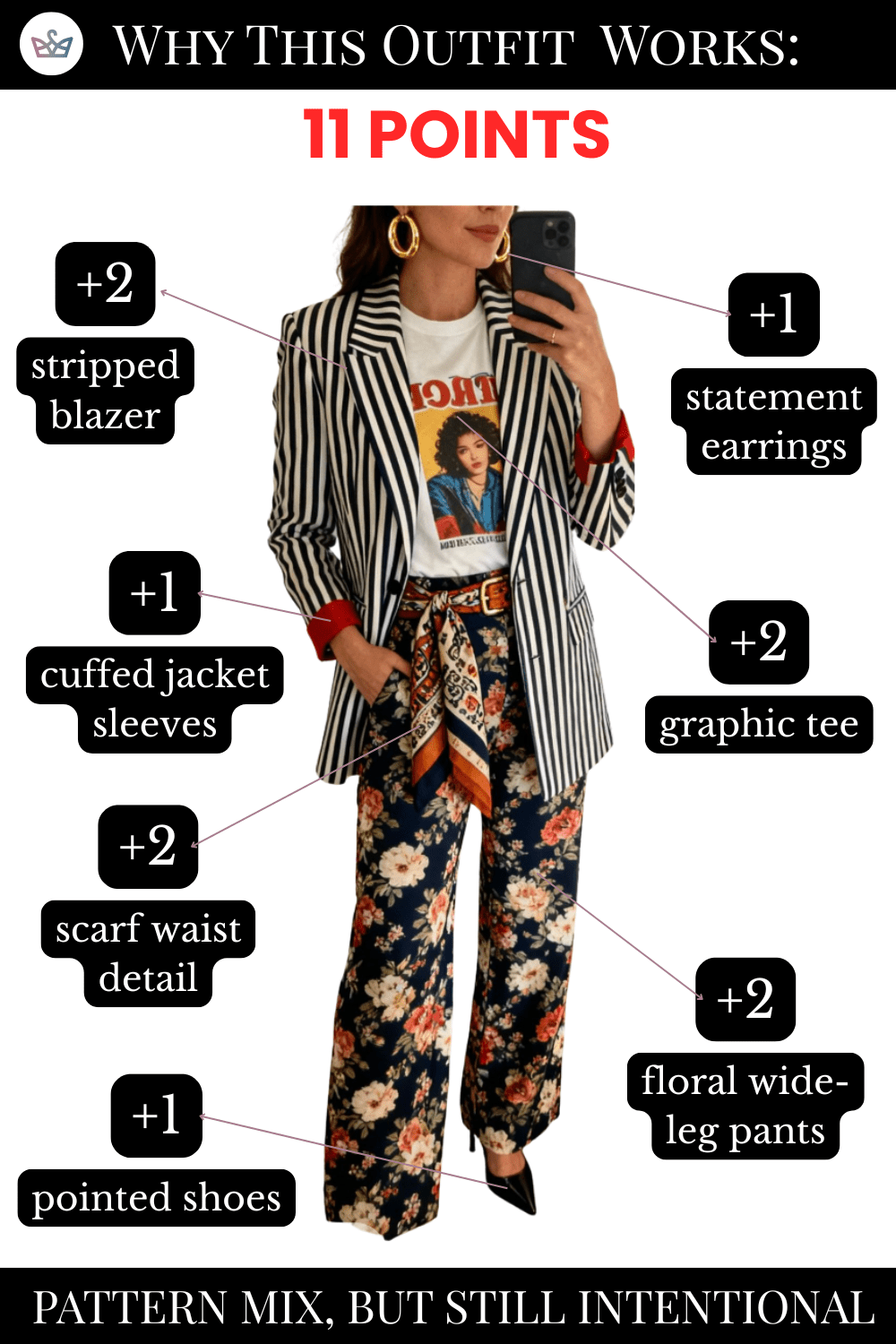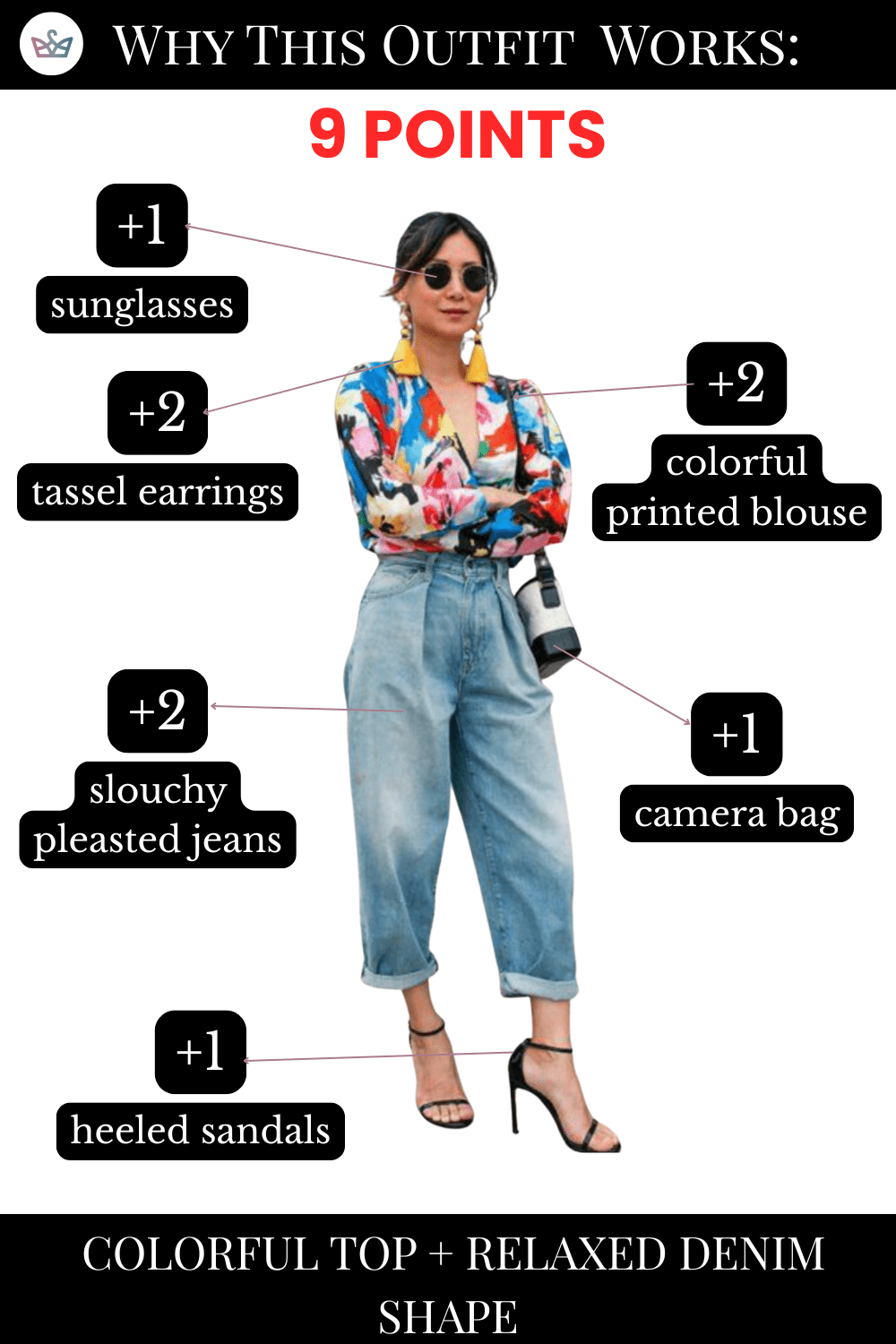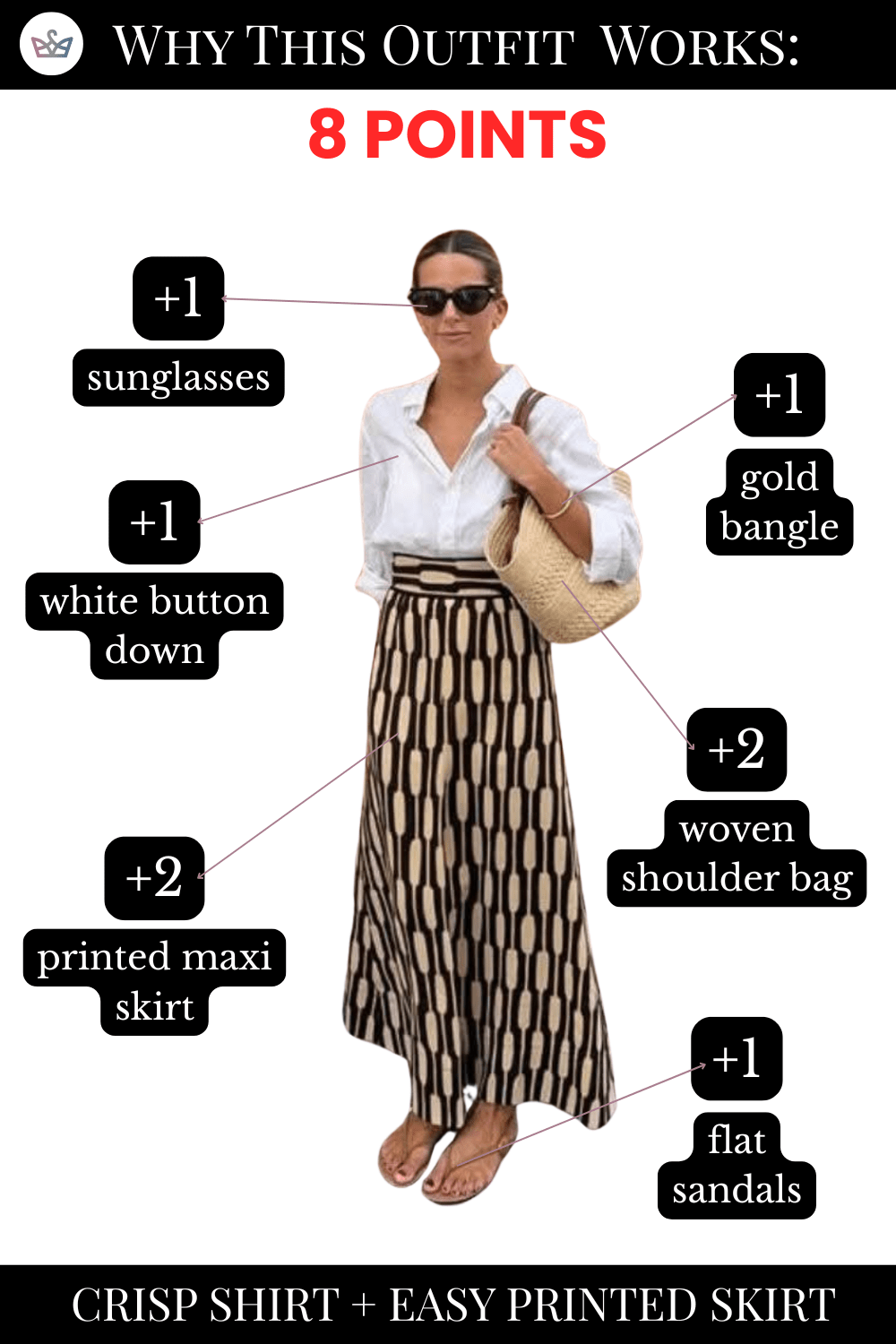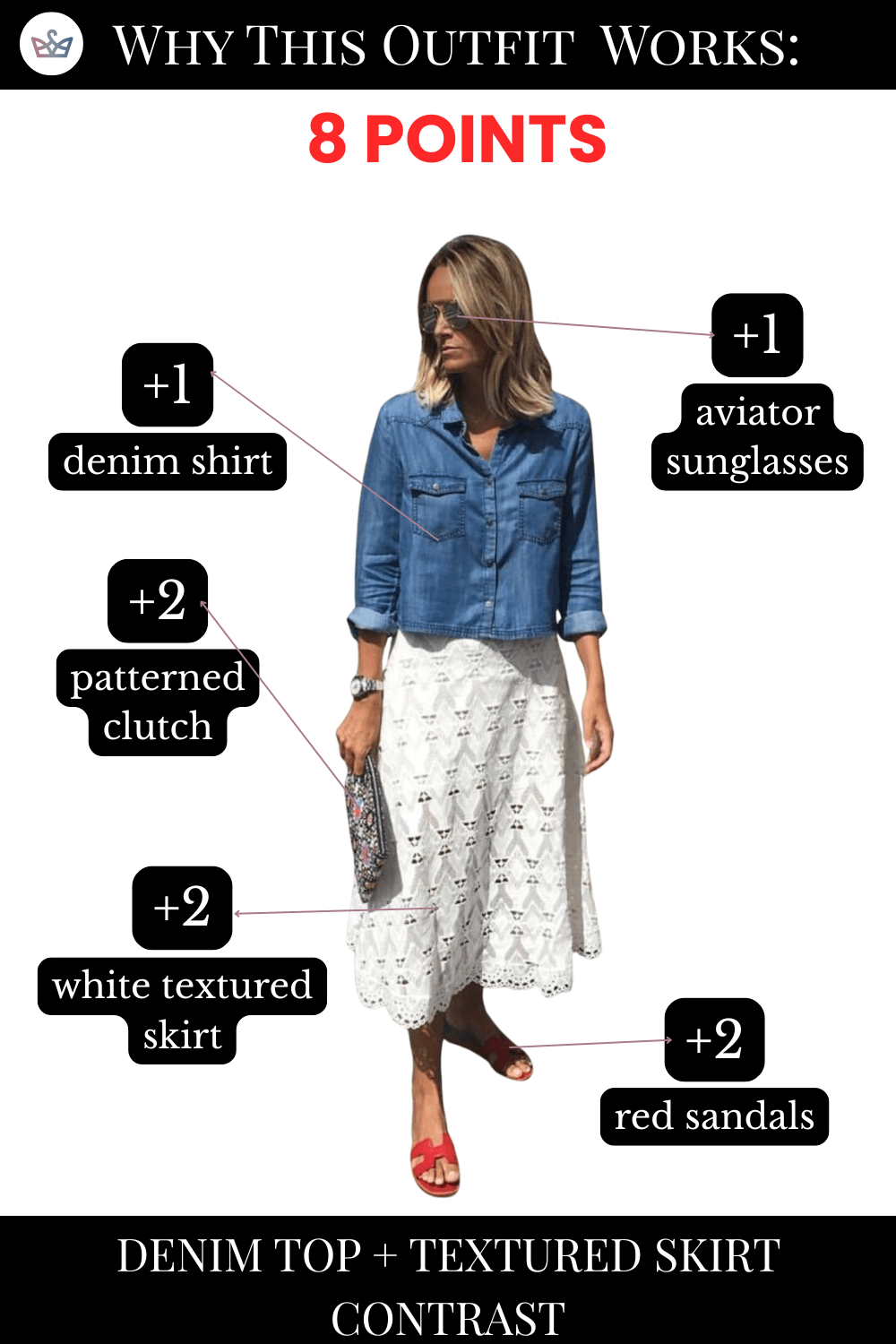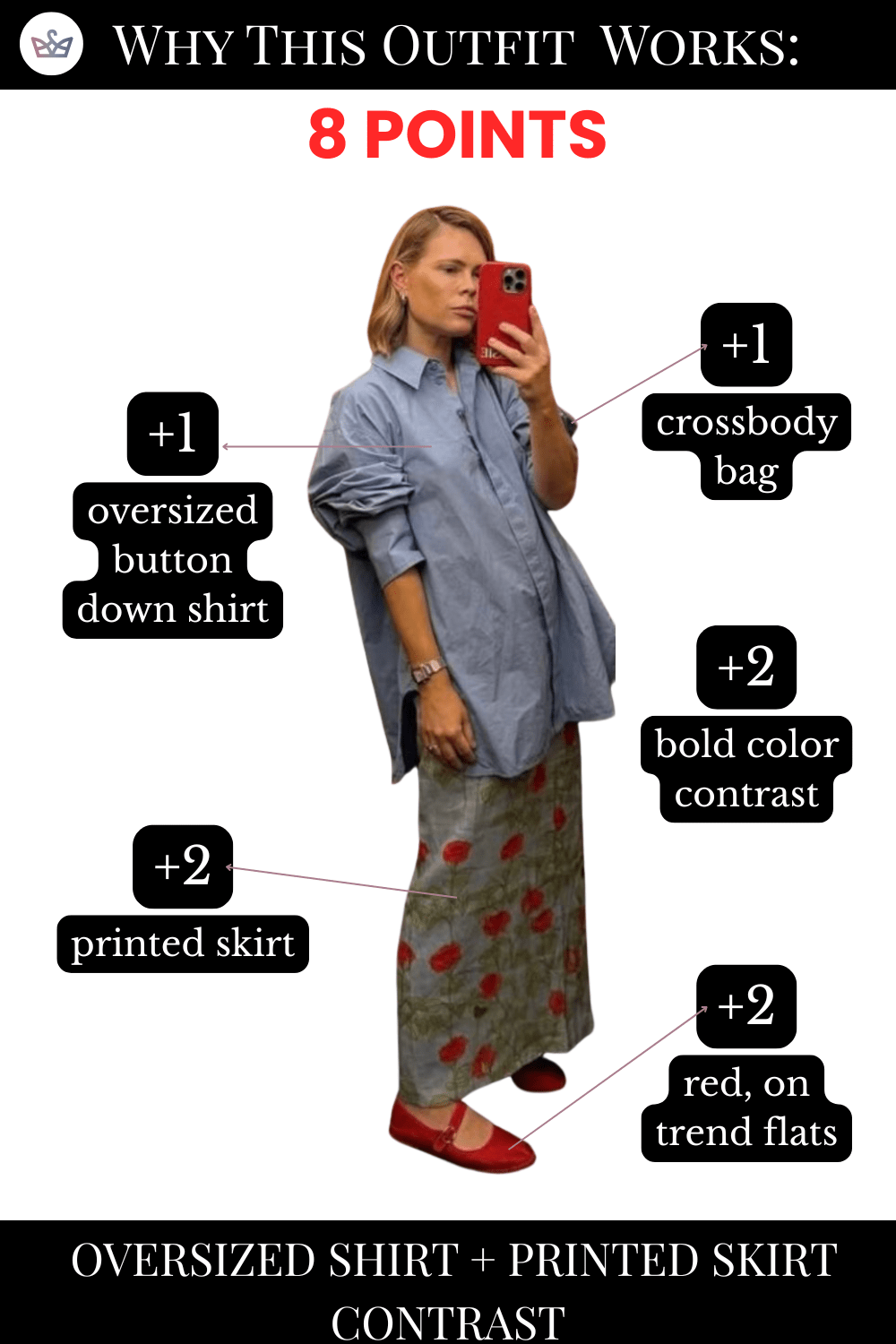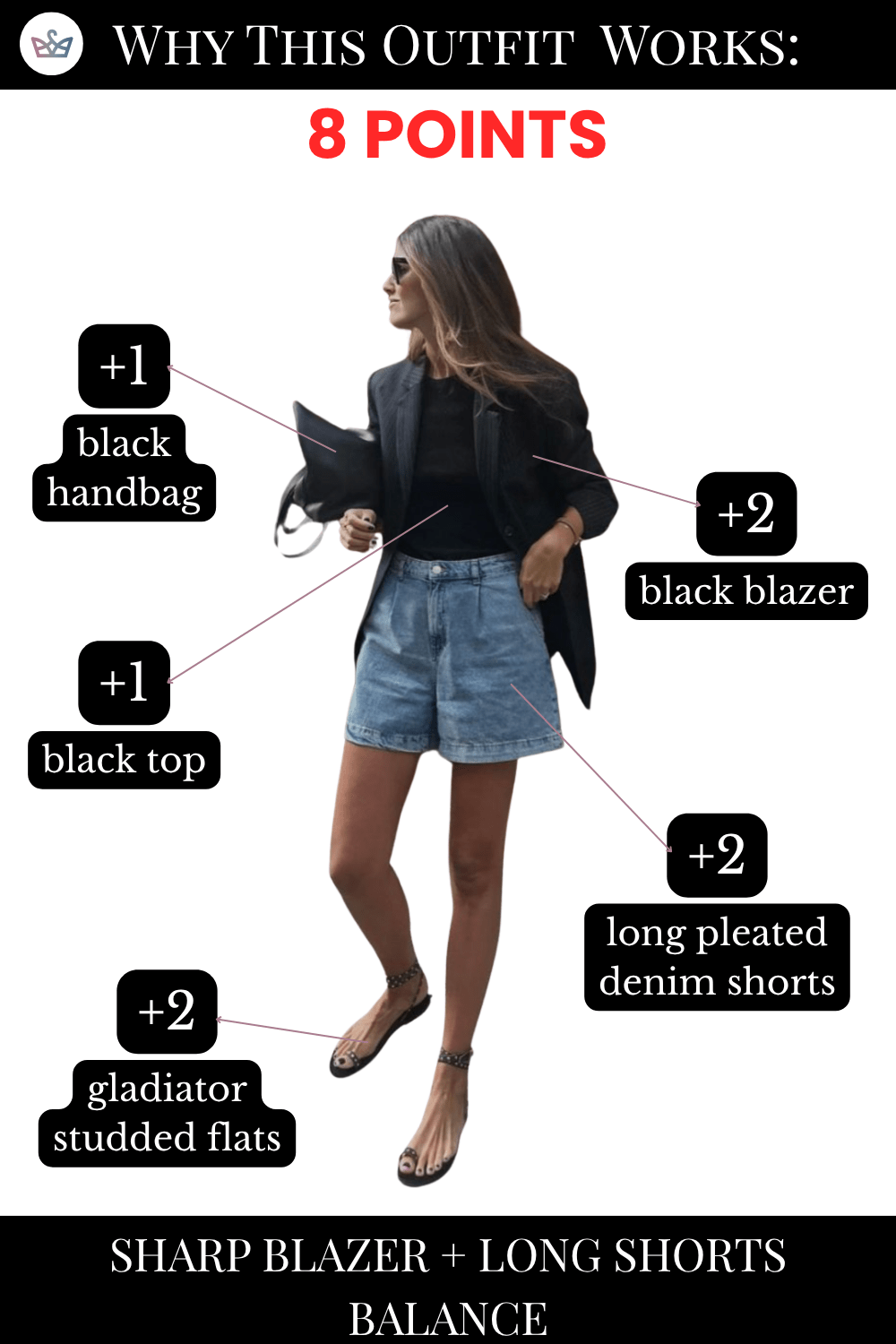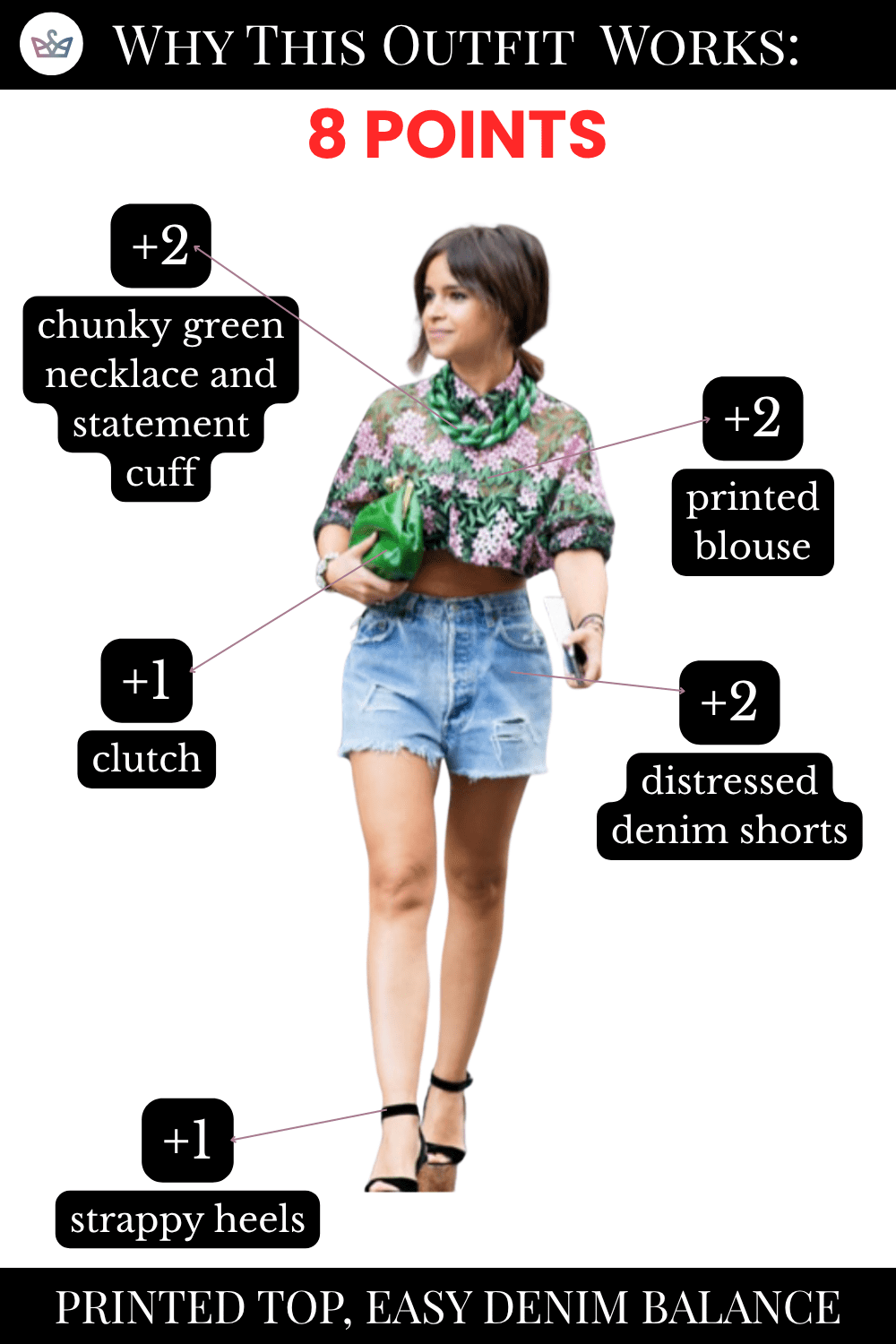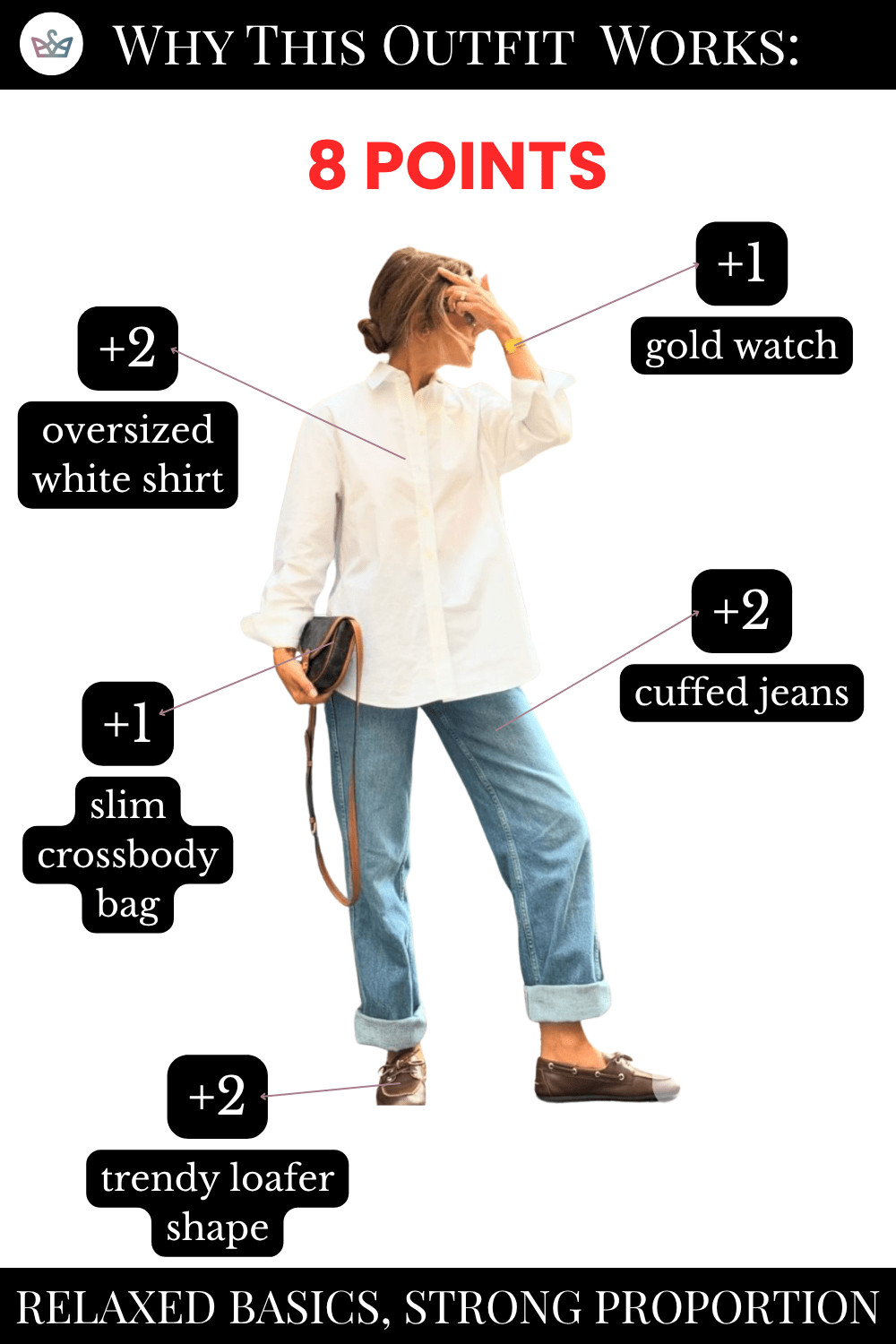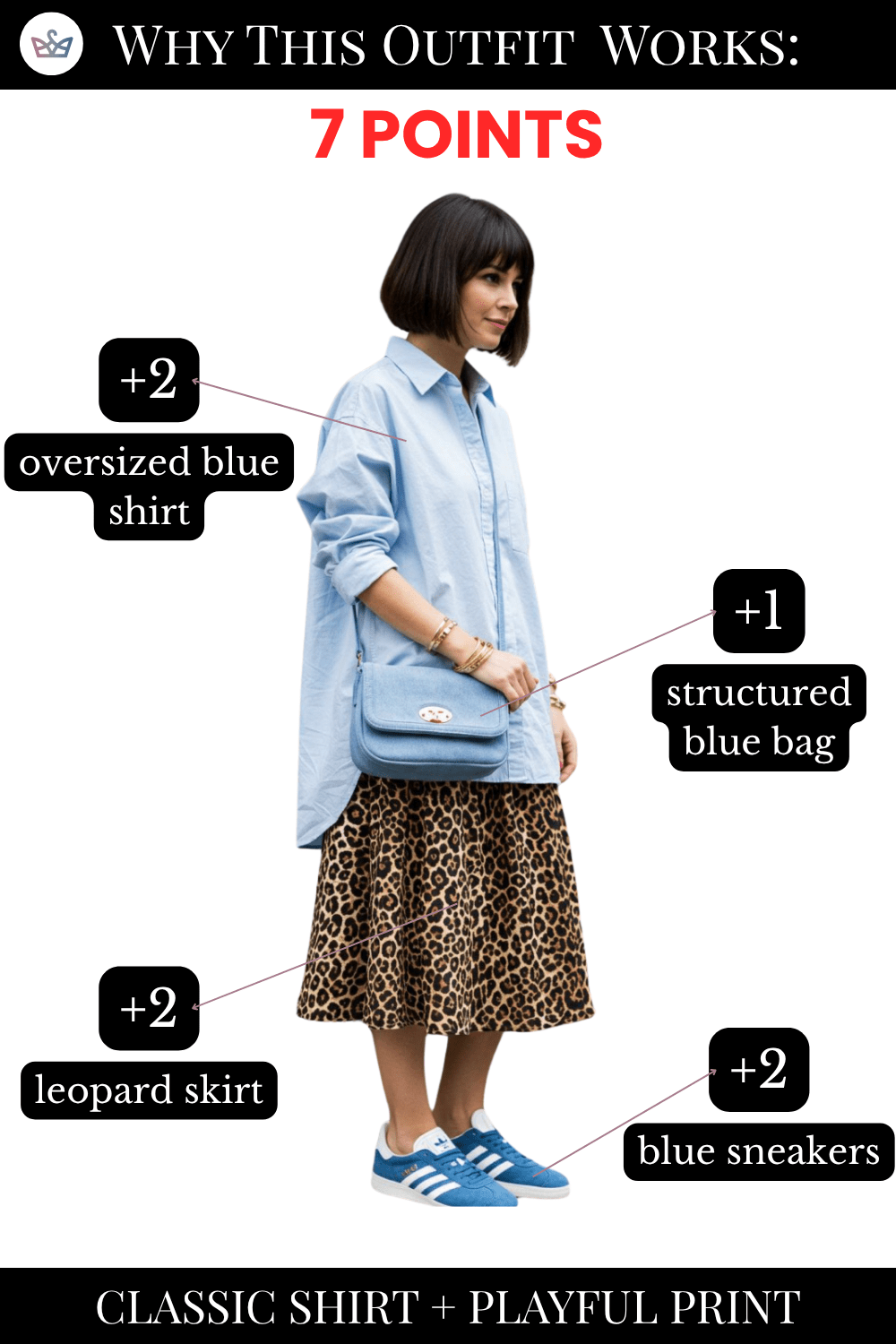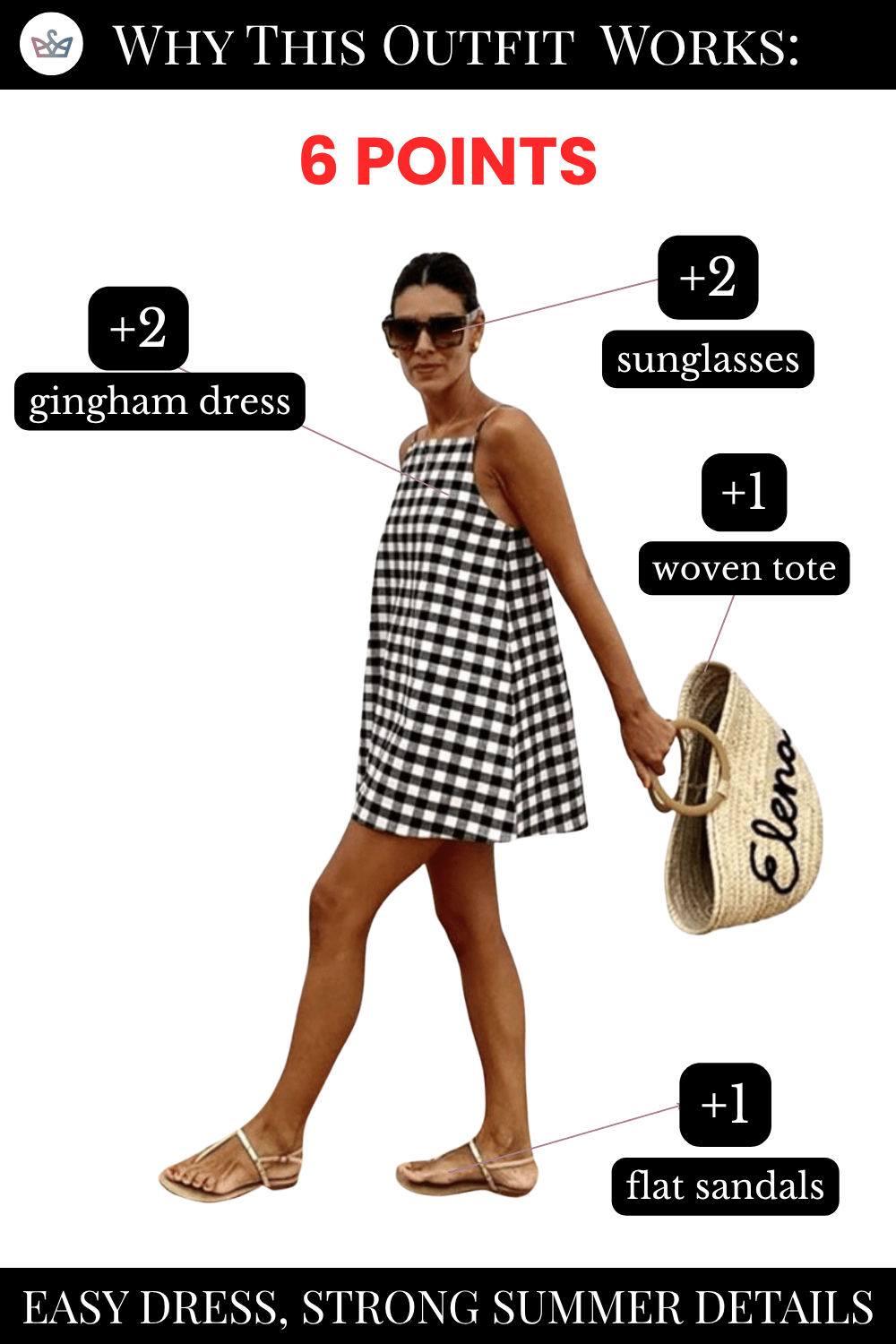
Math and style? What? Rude.
There is a certain kind of fashion advice that sounds helpful for about six seconds and then immediately becomes annoying in real life when you’re, driving carpools, babysitting, or having to wear a uniform.
Add a blazer.
Do a French tuck.
Put on more jewelry.
Wear a “third piece.”
Try harder, apparently, while also pretending it all happened effortlessly.
And sure. Sometimes those tips work.
But sometimes they do not.
Sometimes a blazer makes you look sharper. Sometimes it makes you look like you are cosplaying competence at pickup.
Sometimes more accessories make an outfit feel finished. Sometimes they make you feel jangly, overdone, and strangely unlike yourself.
That is why the outfit point system is interesting when trying to help someone find their style, their sprezzatura or je ne sais quoi.
Not because it gives you one more rule to obey. Not because every good outfit on earth magically equals eight. But because it gives you a way to notice something most people have never put into words:
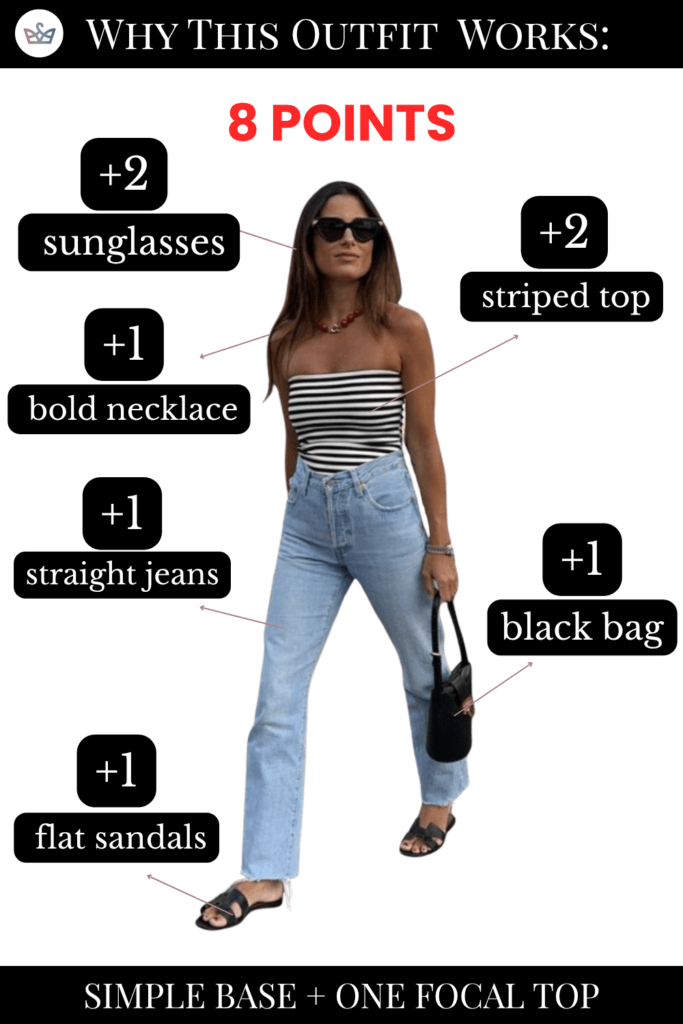
You probably have a preferred level of visual interest. And it doesn’t have to be eight points.
Some women feel best in a clean, low-detail outfit (I wish this were me). Others need a little more contrast, texture, structure, or polish before they feel like themselves (Hi. It me. It can get busy here, peplum-y, puff sleeve-y, pattern-y…) Some come alive with a bag, a belt, a stack of jewelry, and a jacket. Others look incredible the moment they remove two things.
That is where style rules (like the 7 point rule, the 8 point rule, or the Third Piece Rule) gets useful when personalized with Adjust My Crown, your new favorite wardrobe app.
The point is not to hit a perfect number. The point is to figure out your range.
And once you know your range, getting dressed gets much easier.
Why this idea is actually useful
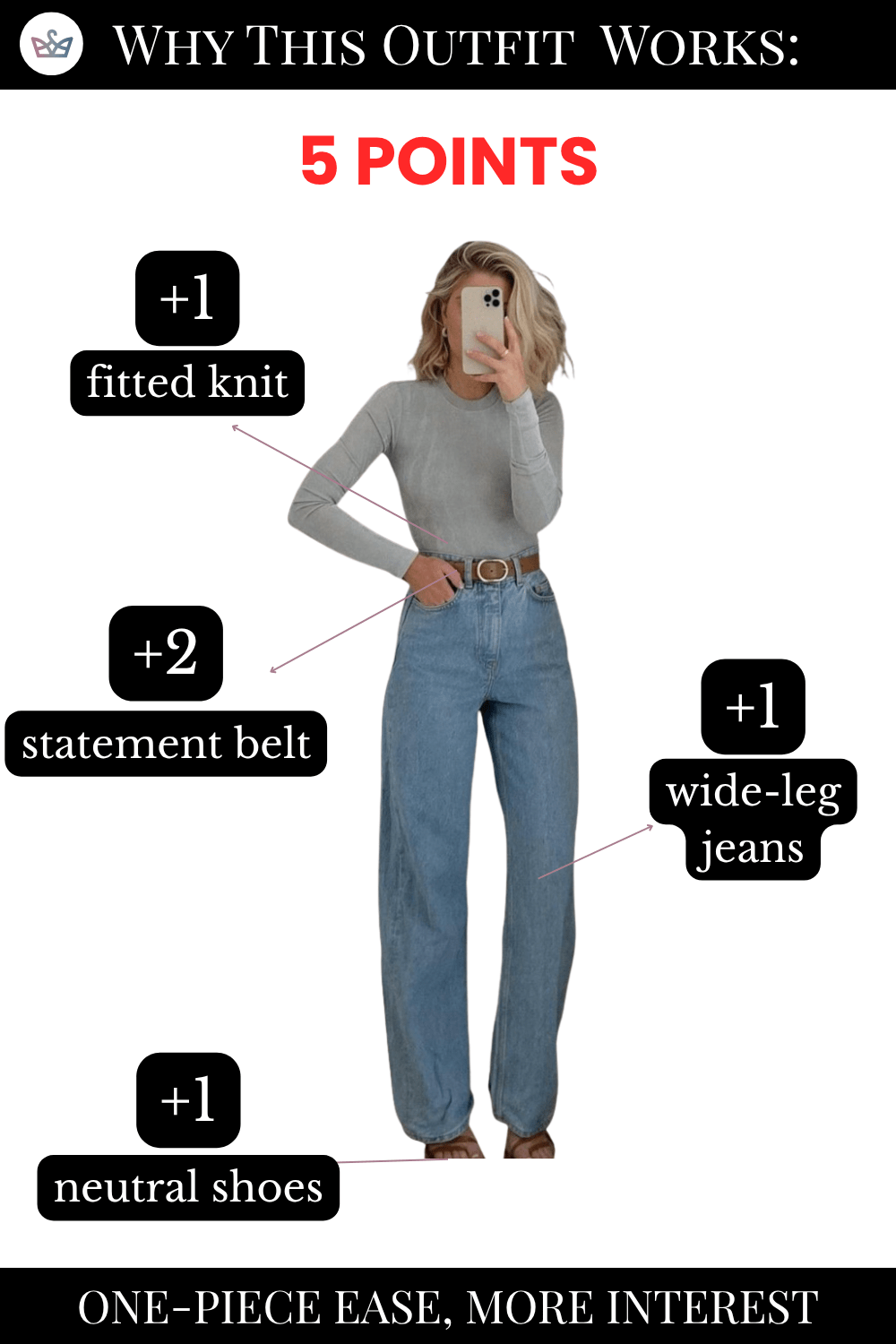
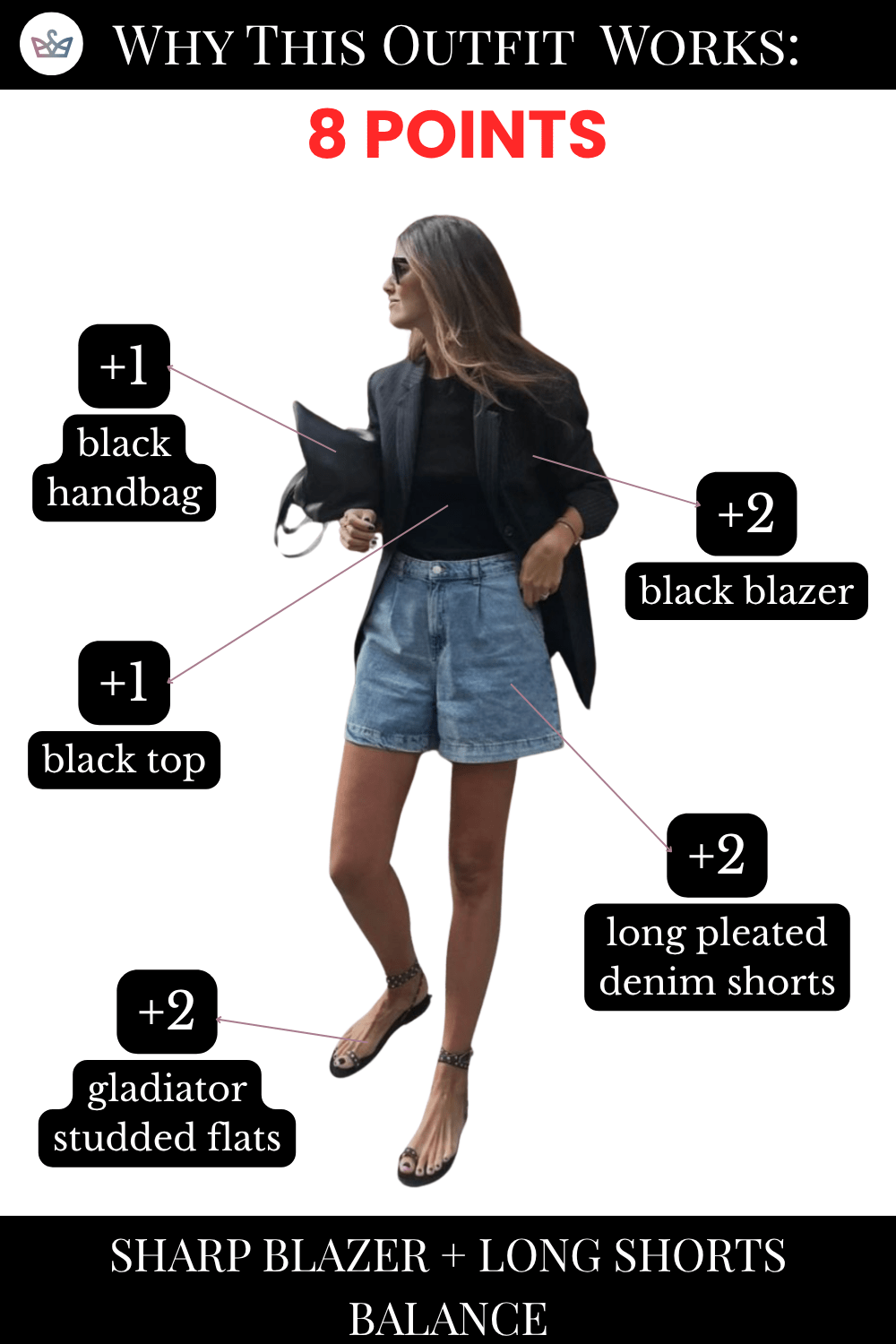
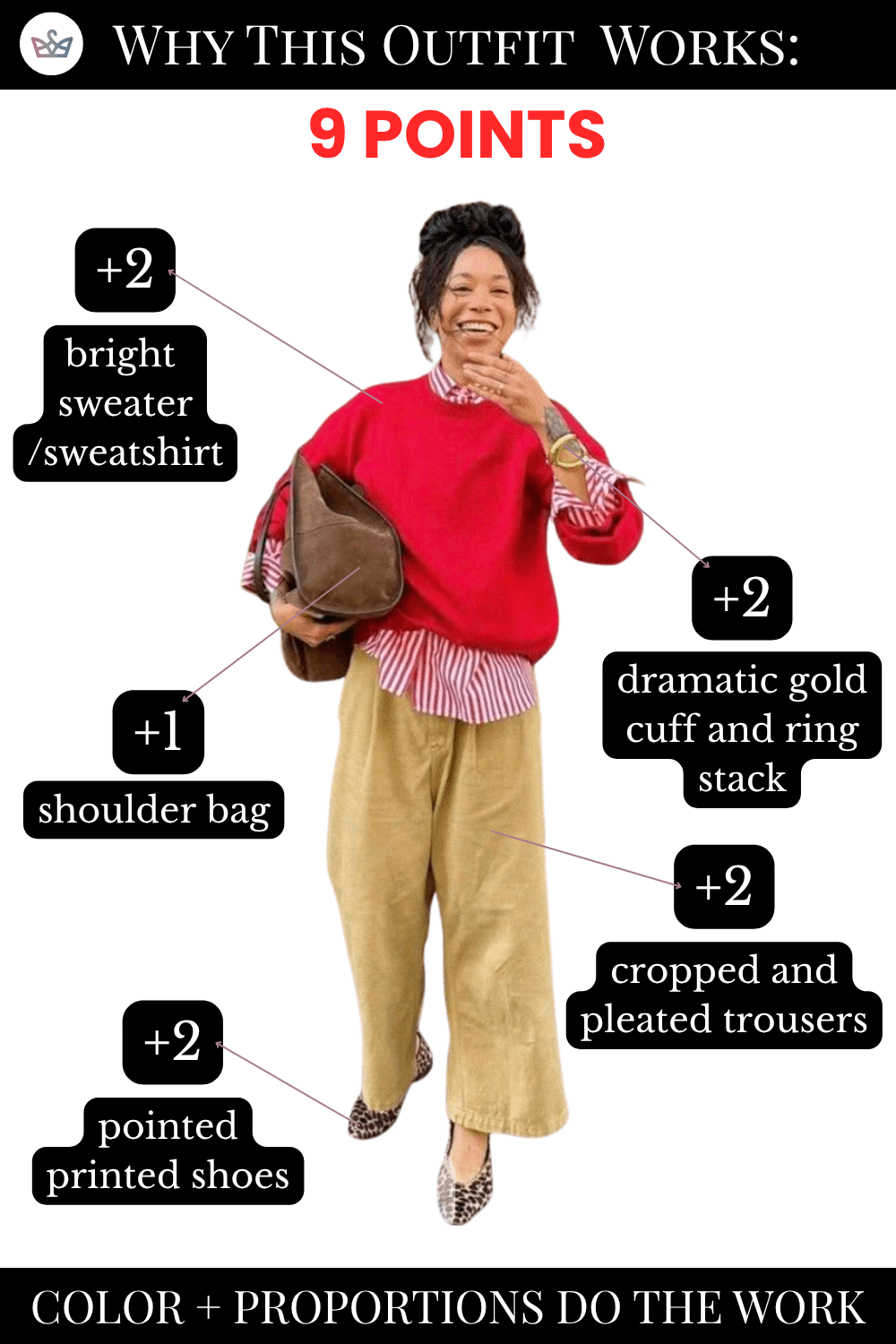
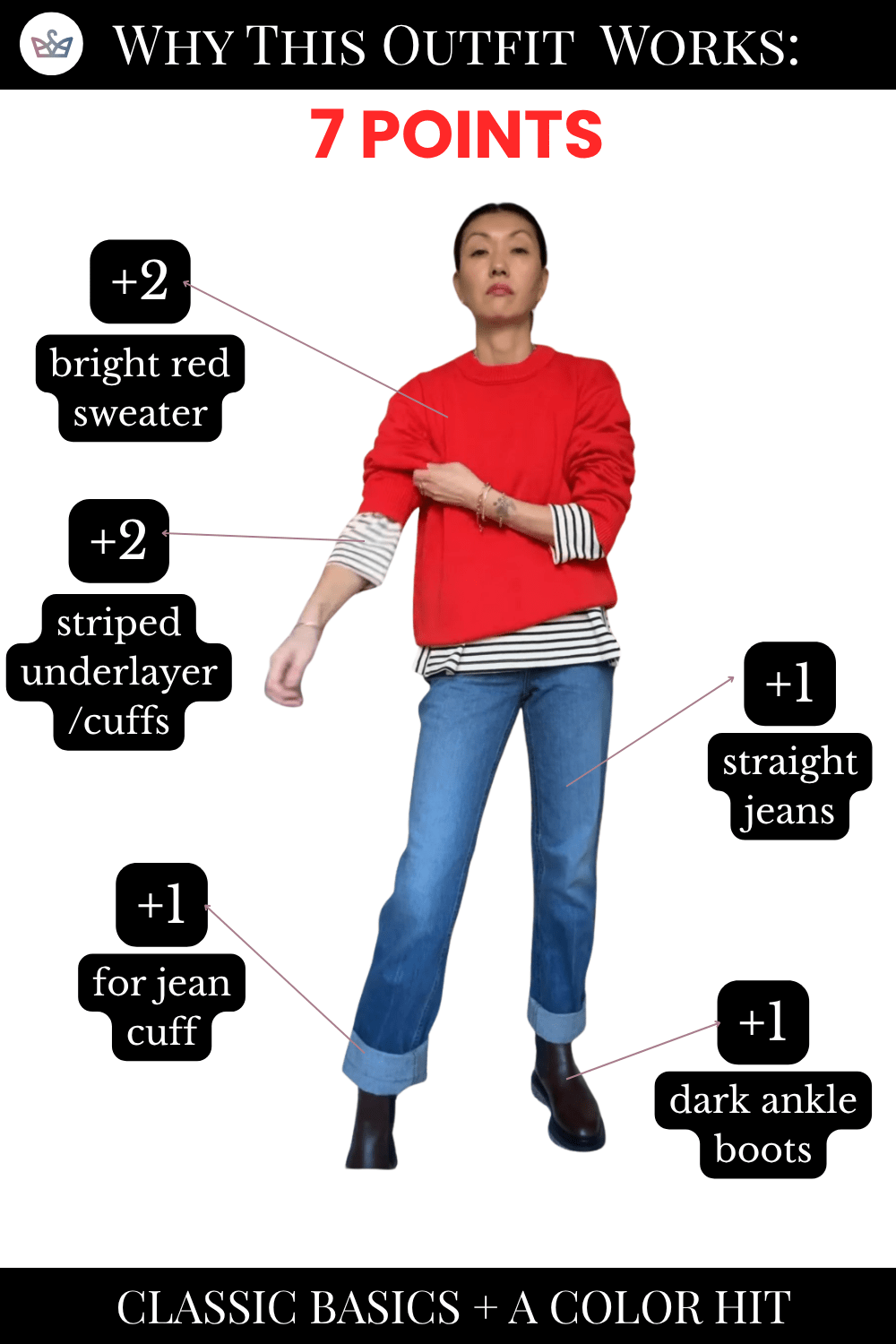
The so-called 7-point or 8-point outfit rule is usually explained like this: every item in your outfit gets a point value. Basics might be worth 1 point. Pieces with more personality, contrast, structure, texture, or trend energy might be worth 2. You add it up, and somewhere around 7 or 8 is supposed to be the sweet spot.
I get why people like it.
It is fast.
It is visual.
It gives a tired brain something to grab onto.
It gives you an equation.
If you love basics but keep ending up in outfits that feel a little too plain, it can help you notice what is missing. Not in a dramatic “reinvent yourself” way. In a practical, grown-woman, “why do I look unfinished when I own perfectly good clothes?” way.
That said, I do not think the lesson is “every outfit should be 8 points.”
That is too rigid. It also ignores context, personality, lifestyle, climate, mood, and the simple fact that some people look fantastic at 4 while others need 9 before the outfit starts speaking.
The smarter takeaway is this:
Your outfits probably live in a range.
And that range says a lot about your style.
The third piece rule is helpful, but incomplete
The third piece rule has survived this long because there is truth in it.
A base outfit can feel flat:
- tee + jeans
- tank + skirt
- sweater + trousers
Then you add one more thing:
- a jacket
- a belt
- a structured bag
- a necklace
- sunglasses
- a scarf
- a different shoe
Suddenly the outfit feels more intentional.
That is real.
But the third piece rule is also incomplete, because it quietly assumes more is always better. It is not.
Sometimes the right third piece transforms the outfit.
Sometimes the third piece is exactly what ruins it.
A minimal outfit can already be done. In fact, some of the chicest outfits in the world are basically three calm, well-chosen elements with no extra circus attached. The issue is not whether you added “a third piece.”
The issue is whether the outfit has the amount of visual interest that feels right on you, for your real life, with your body proportions.
That is a much better question.
It moves us away from formula worship and toward actual style.
The point system, simplified
This does not need to be complicated enough to require a spreadsheet and a support group.
You are just looking at how much visual energy each part of the outfit brings.
A very simple way to think about it:
- basics or expected pieces = usually 1 point
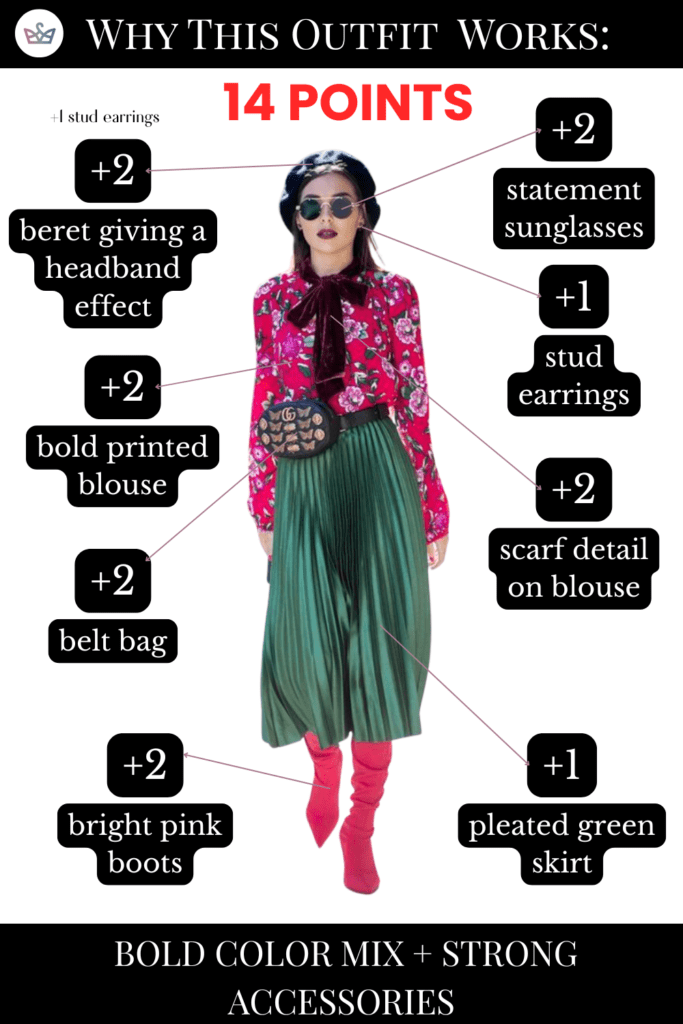
- pieces that are more trend driven or with more contrast, personality, structure, print, shine, color, texture, or statement value = maybe 2 points
That could look like this:
- plain tee = 1
- simple jeans = 1
- shoe = 1
- bag = 1
- hot pink jeans = 2
- peplum tee shirt = 2
- statement earring = 2
- trend-forward jacket = 2
- printed skirt = 2
- bold belt = 2
- layered jewelry = 2
But this is where people get weirdly rigid, and I would not.
Keep in mind that a hoop earring might be 1 point on one person and 2 on another. A leopard flat might feel like a basic in one wardrobe and a statement in another. A bright bag may barely register if you dress colorfully all the time, but feel like a lot if you live in navy, cream, camel, and black.
So no, the internet does not get to assign your points for you like some little fashion accountant.
You do. I am going to try to assign values for illustrative purposes but if you disagree with my fashion accounting, chime in!
The value is in noticing what feels basic, what feels expressive, and what pushes an outfit into your sweet spot.
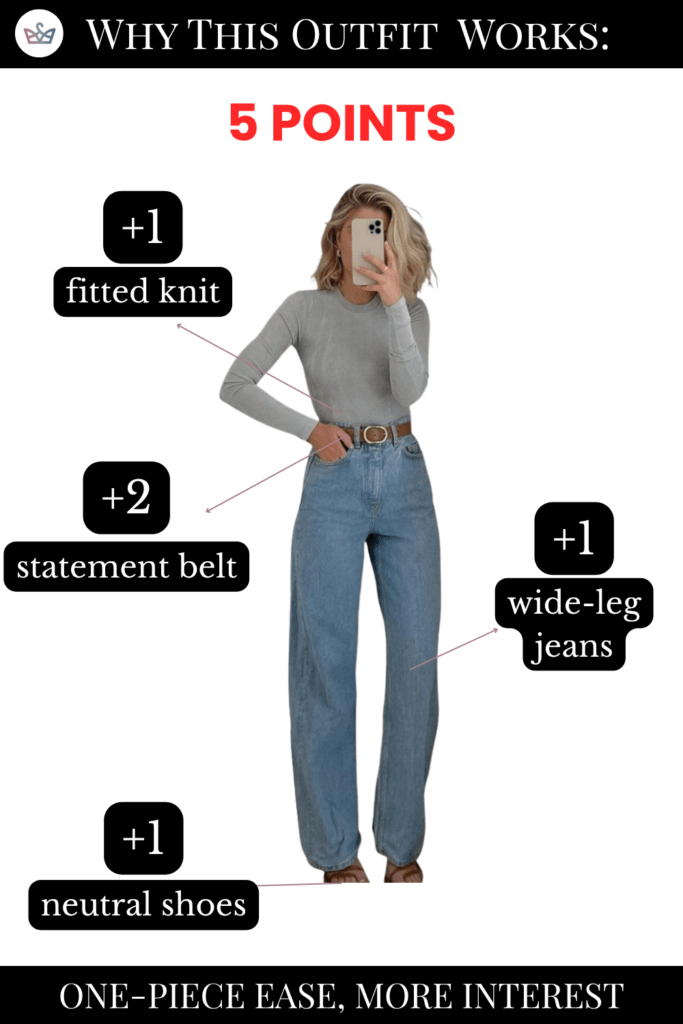
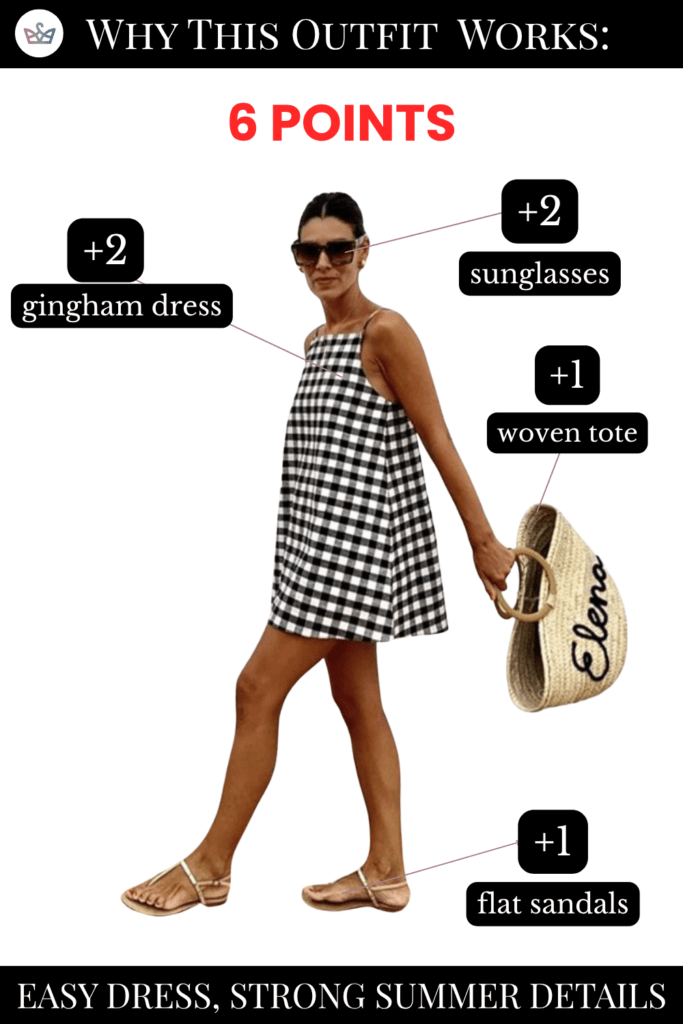
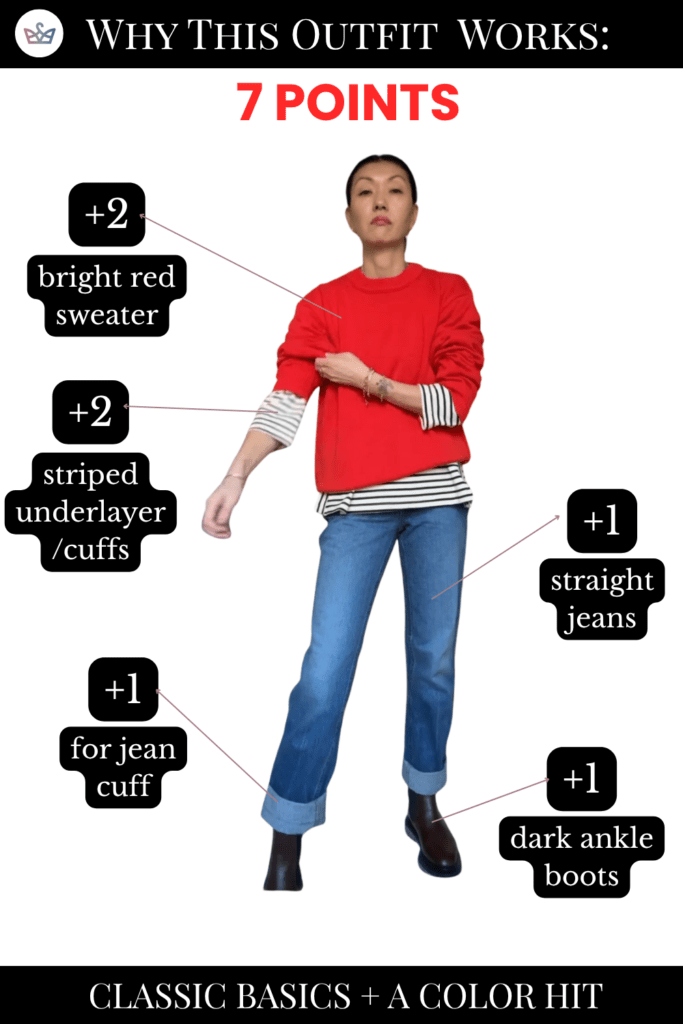
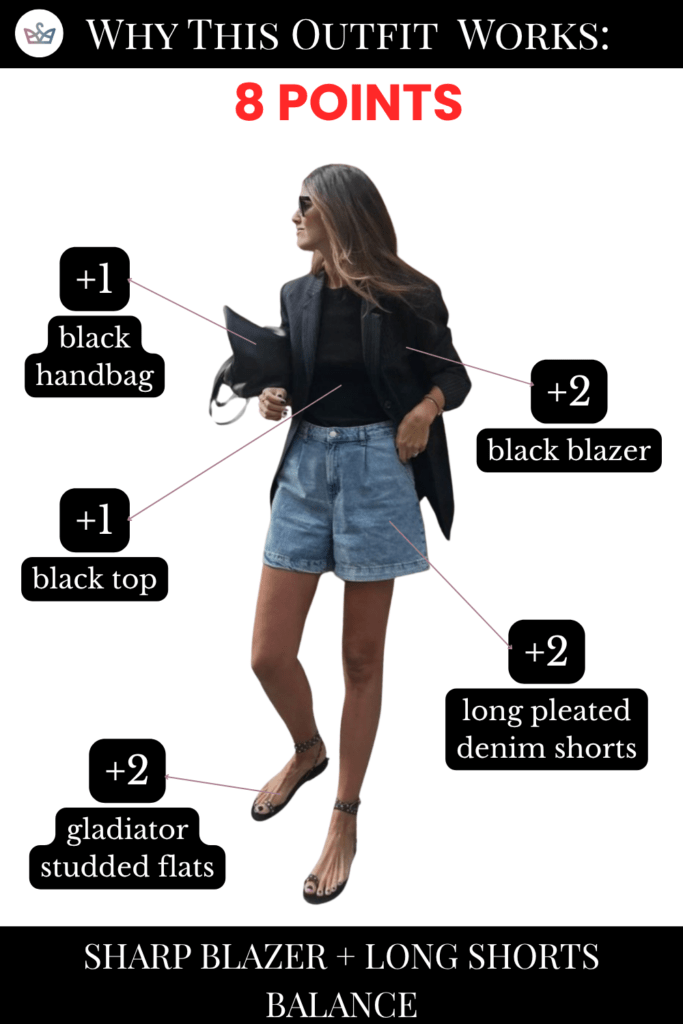
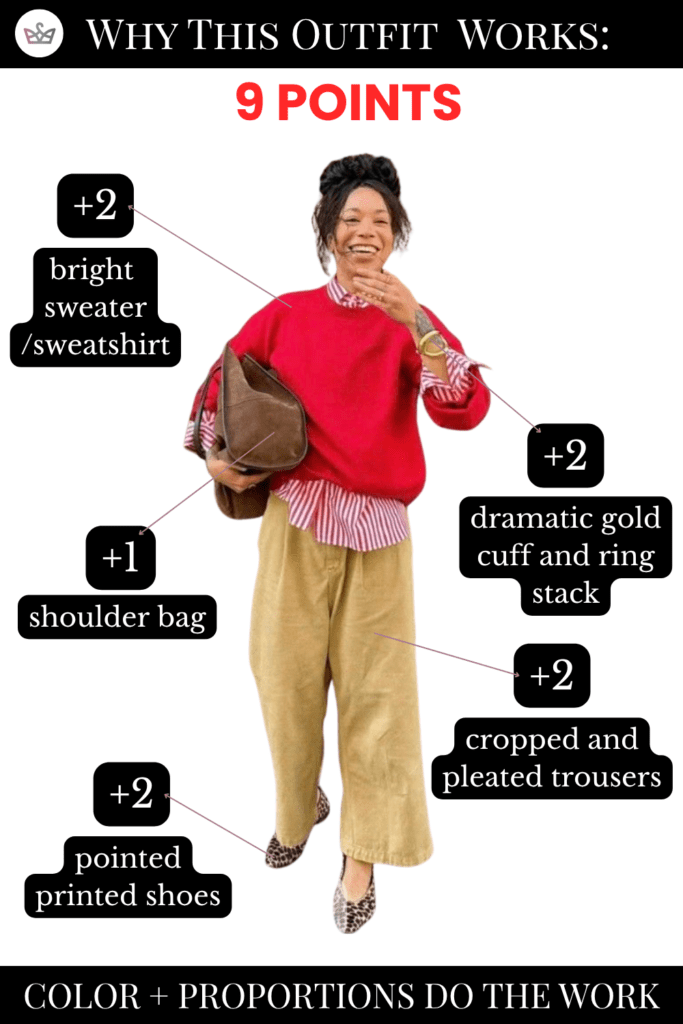
Your best outfits probably live in a range, not at one magic number
This is the part that matters most.
You may not be an “8-point person.” You may be a 4-point person who keeps forcing extra details because you think stylish women always look more accessorized than you. Or you may be a 9-point person who keeps stripping outfits down in pursuit of chic minimalism, then wondering why you feel dull.
That is why this framework is useful for answering the age old and always shifting question, “How To Know My Style.”
Not because it gives you a label.
Because it helps you identify your preferred visual density.
Here is a rough way to think about it:
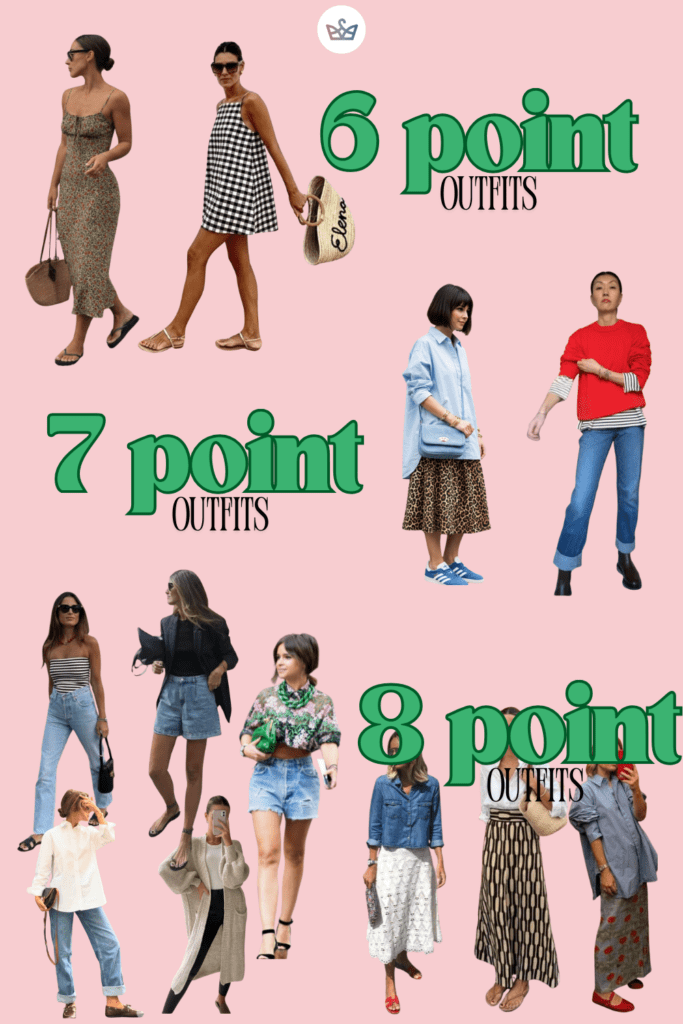
3 to 4 points
These outfits often feel:
- clean
- calm
- minimal
- easy
- unfussy
This range can look incredibly chic on the right person. It often works well for women who prefer restraint, low-maintenance dressing, or a quieter silhouette.
5 to 7 points
This is often the most balanced range for everyday life.
Not too plain.
Not too styled.
Not trying to prove anything.
A lot of women live happily here because it feels polished without feeling precious.
8 to 10 points and up
This is where outfits start to feel more expressive, layered, styled, or fashion-forward.
It can be fantastic. It can also feel like too much if it is not actually you.
And that is the whole point: the “best” range is not the highest one. It is the one that makes you look and feel most like yourself. This will also change from season to season and over the course of your life. This is why ‘remembering’ and saving your fits on Adjust My Crown is so helpful. You can watch the metamorphosis and spend a lot LESS time on style and shopping.
That is a much more honest route to “How To Find Your Style” than chasing whatever the current fashion internet is yelling at you about. It’s the outfit inspiration equivalent of going for a walk and clearing your head.
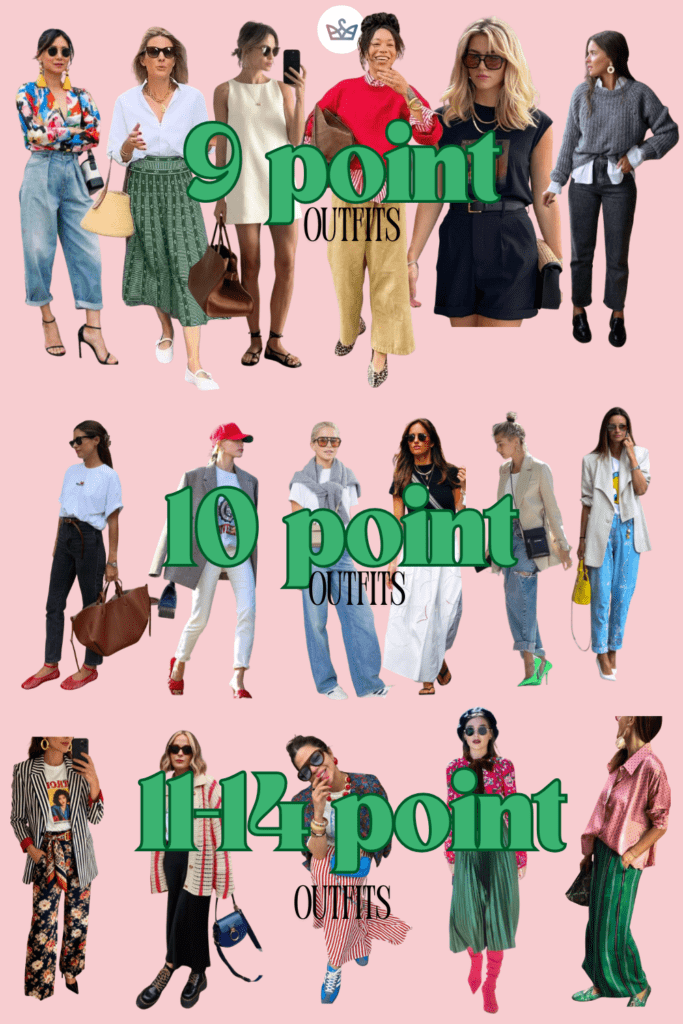
Context changes the score
This is where a lot of style advice falls apart. It acts like the same woman should want the same outfit energy for every part of her life.
Absolutely not.
Working from home is different from dinner out.
A school morning is different from a vacation city walk.
A rainy grocery run is different from a meeting, a date, or a birthday lunch.
You may want a lower point range at home because you are not wearing shoes, carrying a bag, or stacking on details before coffee. You may want more points when you leave the house because an outfit needs a little more structure to feel complete in public. The same earring might feel barely noticeable at dinner and slightly ridiculous while scrambling eggs.
That is not inconsistency. That is reality.
It is also why this concept is more helpful when you think of it as flexible.
You are not trying to become one fixed number.
You are trying to learn your range by situation.
That is much more practical for advice for “How To Put Together An Outfit” you will actually wear, instead of one that only looks good standing still in a mirror for twelve seconds that you slowly shed over the course of the day.
Why some “styling” advice feels fake in real life
This is also worth saying out loud: some women do not need more styling tips. They need less nonsense.
A lot of fashion content makes it sound like basic clothes become magical if you:
- cuff this
- half-tuck that
- stack these
- drape a sweater just so
- balance an architectural shoe with a vintage cuff and an ironic bag charm and the tears of a Paris editor
And yes, tiny styling tweaks can help.
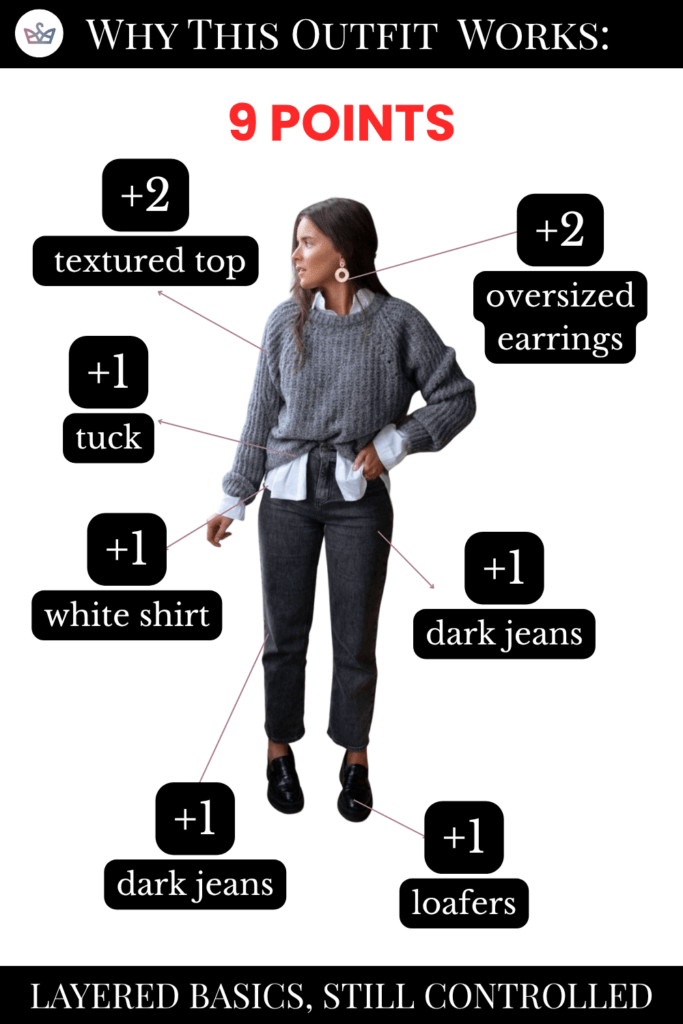
But the frustration is real. Plenty of people do not want to babysit an outfit all day. They do not want to redo a perfect tuck every time they use the bathroom. They do not want to spend their lives maintaining a “casually undone” arrangement that took active management.
That is why the point system can be more helpful than generic advice about styling clothes.
It shifts the question from:
“What trick do stylish people do?” to style their outfits
to:
“What amount of detail makes this outfit feel right for me, today, without becoming annoying?”
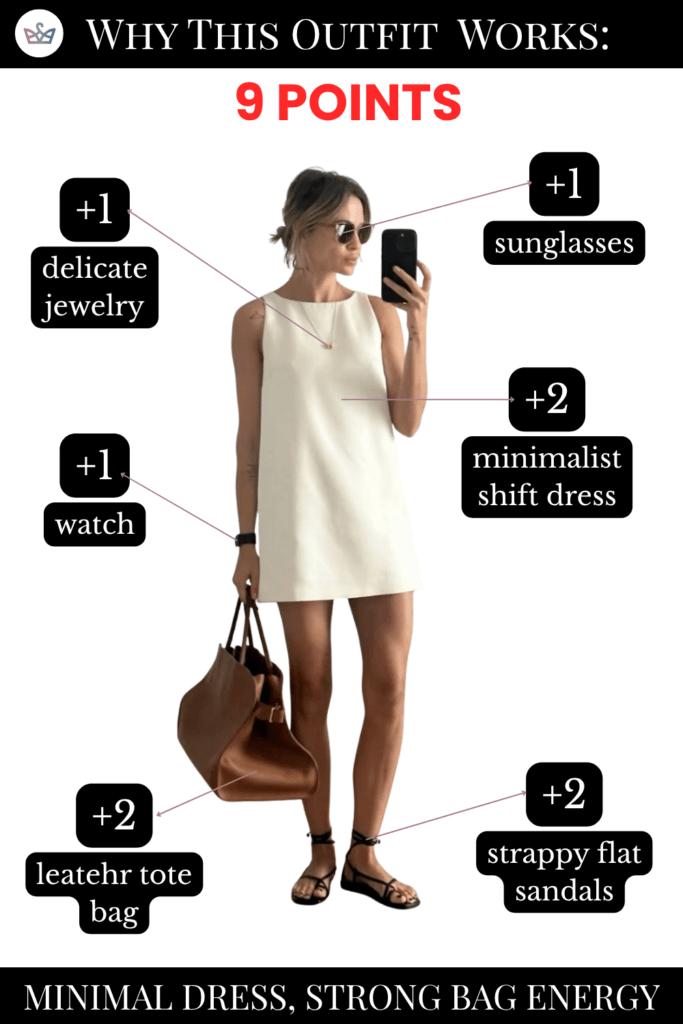
That is a better question. It respects real life.
Because sometimes the answer is not “add another thing.” Sometimes it is:
- wear the better shoe
- switch to the more structured bag
- choose the printed skirt
- keep the jewelry simple
- stop there
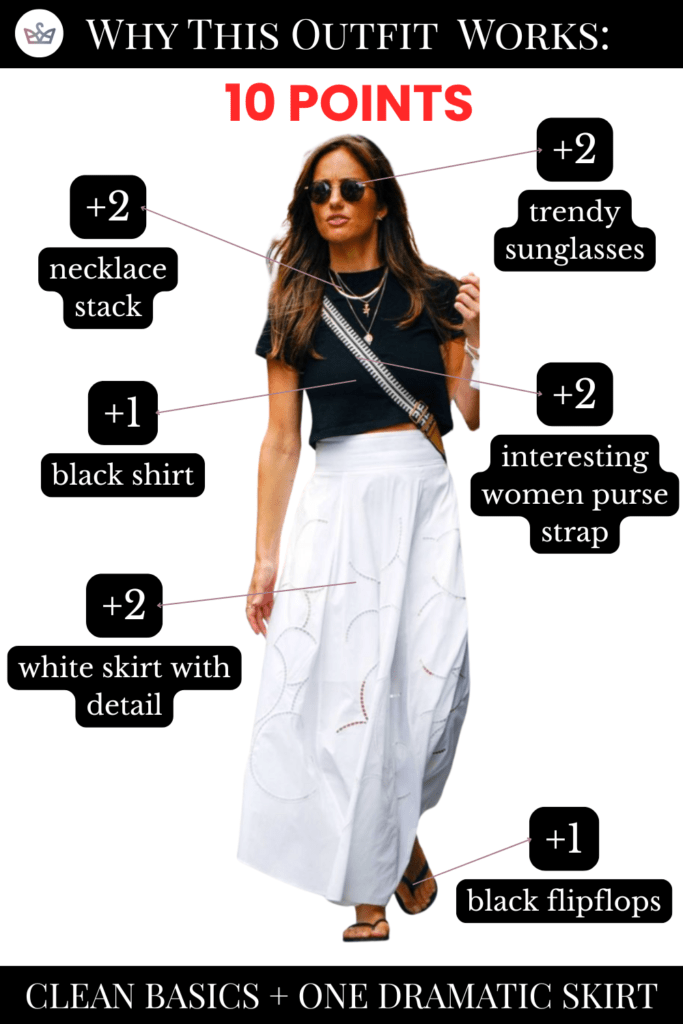
One intentional move can do more than four fussy ones.
Style mistakes people make with this idea
This part matters, because the point system can absolutely help you, but it can also send you straight into outfit overthinking if you use it badly.
Adding pieces instead of adding intention
This is the biggest mistake.
People hear “your outfit needs more points” and start piling on extras. More jewelry. Another layer. A scarf. A hat. A belt. A bag with “personality.” Suddenly the outfit looks like it is carrying its own luggage.
More pieces do not automatically mean more style.
Sometimes the smartest move is not adding. It is swapping. A sleeker sandal instead of the tired one. A structured bag instead of the slouchy emergency tote. A bolder earring instead of three forgettable accessories that do not say much.
Choosing trendy extras that fight the base outfit
A good outfit has internal logic.
If the base is classic and calm, a random hyper-trendy add-on can feel like it wandered in from another person’s closet. Not every trend belongs in every outfit. OR, it can be the exact thing to wake up the outfit, because it’s worth more “points” and you like a higher point range. The point system should help you refine, not distract or make you crazy and an overthinking nightmare.
The question is not “does this add points?” for the sake of adding points.
It is “does this belong here, on me?”
Assuming more points = better style
No.
That is the lie people love because it sounds productive.
But more is not automatically better. More can be:
- cluttered
- try-hard
- costume-y
- noisy
- exhausting
Some of the best outfits are simple and sharp. Some women get more elegant the fewer things they wear. If your outfit looked best at 4 and you forced it to 8 because some internet lady said that was the sweet spot, congratulations, you have just accessorized yourself away from your own face.
Copying someone else’s preferred range
This one is sneaky.
You save an outfit on Pinterest. You admire someone on Instagram. You love the look of a celebrity, a stylist, or a beautifully dressed stranger who seems to float around town in gold hoops, wide-leg trousers, sunglasses, and ten pounds of confidence.
Lovely.
That still does not mean her range is your range or her body is your body or her lifestyle is your lifestyle.
What looks balanced on one person can look overworked on another. What looks effortless on someone else can feel silly on you. That is not failure. It is information.
Using points to override your own instincts
This may be the most important one.
If you liked the outfit before you “fixed” it, pay attention to that. If adding more makes you feel less like yourself, that matters. The point system should sharpen your instincts, not bulldoze them.
It is a tool, not a tiny dictator.
The real goal is not to hit 8. It is to find your threshold.
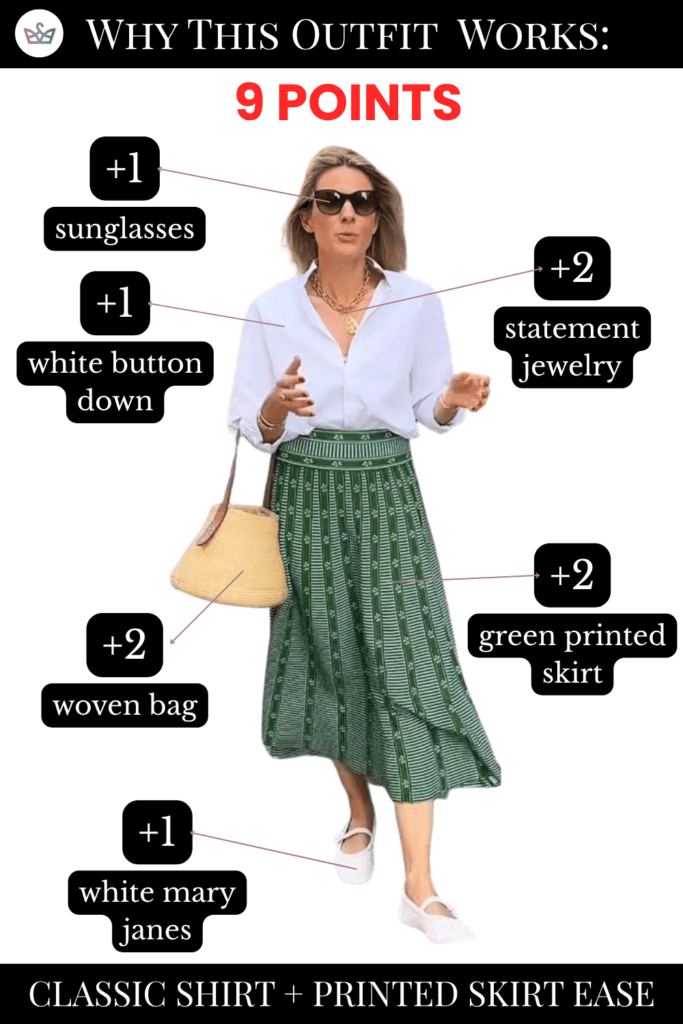
This is where most style content gets lazy. It gives you a rule and calls it clarity.
But style usually does not improve because someone told you the right number of accessories or the correct jacket length or the exact ratio of polished to relaxed. Style improves when you start noticing your threshold.
How much is enough for you? 4? 13?
How much is too much? 6? 15?
At what point does an outfit wake up? 7? 8?
At what point does it get noisy? 6? 9?
That threshold is incredibly valuable and personal.
Because once you know it, shopping gets smarter. Editing gets easier. Styling outfits gets easier. You stop constantly wondering why an outfit technically “works” but still does not feel like you.
You also stop trying to become the wrong kind of stylish.
That alone could save people a lot of money and several regrettable earrings.
What this has to do with AMC
A lot of style advice assumes that if people just hear enough good tips, they will magically develop taste, confidence, and clarity.
I’ve never seen it work that way.
Advice does not change style. Self to self comparison does with side-by-side outfit selfies.
You do not learn your style by collecting more adjectives. You learn it by seeing:
- the same base outfit
- one variable changed
- one version clearly better
That is why Adjust My Crown fits this idea so naturally.
Not because AMC tells you there is one correct number of points.
Not because it forces every outfit into some rigid style formula.
But because it lets you test your threshold.
Try the outfit at 4 points.
Try it again at 6.
Try it again at 8.
Then compare.

The difference between “I think I like simpler outfits” and “I consistently choose the cleaner version when I see them side by side” is huge. One is a vague self-description. The other is evidence.
That is what makes this useful.
You are not saying:
here is the correct number of points.
You are saying:
here is how to discover the amount of visual interest you actually prefer.
That is a much more intelligent way to approach How To Elevate Your Outfit. And frankly, it is a much better answer to How To Style Basic Clothes than “just add a blazer.”
How to test your own point range
This is the practical part.
Start with one base outfit you already wear:
- tank + jeans
- tee + skirt
- sweater + trousers
- button-down + denim
Then make a few versions.
Version 1: lower-point
Keep it clean and minimal.
Version 2: mid-point
Add one or two intentional details.
Version 3: higher-point
Push the outfit a little further with more visible interest.
Then compare them side by side.
Not in theory.
Not in your imagination.
Actually compare them, using things from your own closet.
This is how you learn:
- whether you like restraint or contrast
- whether your outfits need more structure
- whether jewelry helps or distracts
- whether a “third piece” sharpens your look or clutters it
- whether your best outfits are quieter or more expressive
That is the practical path for How To Put Together An Outfit that feels like you instead of one that sounds good in a caption.
So, are you a 3-point dresser or a 10-point dresser?
Maybe neither.
Maybe you are a 4 by day and a 7 by night. Maybe summer brings you down to 3 and fall pulls you up to 6. Maybe you love a basic outfit but need one sharper element to keep it from feeling sleepy. Maybe you have spent years adding too much because you thought style had to look busier than it actually does.
That is why this framework is worth trying.
Not because it gives you another rule.
Because it helps you see yourself more clearly.
And that is really what people are looking for when they search How To Find Your Style or How To Know My Style in the first place. They are not asking for a costume. They are asking for recognition. They want to know when an outfit looks right, why it looks right, and how to repeat that on purpose.
The point system can help with that.
The third piece rule can help with that too.
But the real shift happens when you stop asking what is “correct” and start noticing which level of visual interest feels most like you.
That is where your style begins.