
How To Find Your Style: Are You a 3-Point Dresser or a 10-Point Dresser?
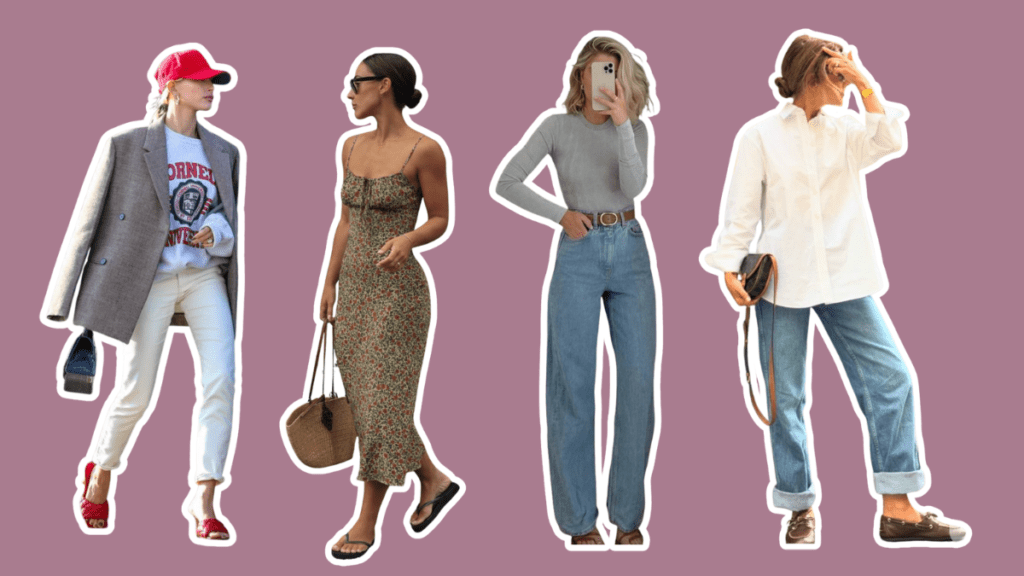
Math and style? What? Rude. There is a certain kind of fashion advice that sounds helpful for about six seconds and then immediately becomes annoying in real life when you’re, driving carpools, babysitting, or having to wear a uniform. Add a blazer.Do a French tuck.Put on more jewelry.Wear a “third piece.”Try harder, apparently, while also pretending it all happened effortlessly. And sure. Sometimes those tips work. But sometimes they do not. Sometimes a blazer makes you look sharper. Sometimes it makes you look like you are cosplaying competence at pickup. Sometimes more accessories make an outfit feel finished. Sometimes they make you feel jangly, overdone, and strangely unlike yourself. That is why the outfit point system is interesting when trying to help someone find their style, their sprezzatura or je ne sais quoi. Not because it gives you one more rule to obey. Not because every good outfit on earth magically equals eight. But because it gives you a way to notice something most people have never put into words: You probably have a preferred level of visual interest. And it doesn’t have to be eight points. Some women feel best in a clean, low-detail outfit (I wish this were me). Others need a little more contrast, texture, structure, or polish before they feel like themselves (Hi. It me. It can get busy here, peplum-y, puff sleeve-y, pattern-y…) Some come alive with a bag, a belt, a stack of jewelry, and a jacket. Others look incredible the moment they remove two things. That is where style rules (like the 7 point rule, the 8 point rule, or the Third Piece Rule) gets useful when personalized with Adjust My Crown, your new favorite wardrobe app. The point is not to hit a perfect number. The point is to figure out your range. And once you know your range, getting dressed gets much easier. Why this idea is actually useful The so-called 7-point or 8-point outfit rule is usually explained like this: every item in your outfit gets a point value. Basics might be worth 1 point. Pieces with more personality, contrast, structure, texture, or trend energy might be worth 2. You add it up, and somewhere around 7 or 8 is supposed to be the sweet spot. I get why people like it. It is fast.It is visual.It gives a tired brain something to grab onto. It gives you an equation. If you love basics but keep ending up in outfits that feel a little too plain, it can help you notice what is missing. Not in a dramatic “reinvent yourself” way. In a practical, grown-woman, “why do I look unfinished when I own perfectly good clothes?” way. That said, I do not think the lesson is “every outfit should be 8 points.” That is too rigid. It also ignores context, personality, lifestyle, climate, mood, and the simple fact that some people look fantastic at 4 while others need 9 before the outfit starts speaking. The smarter takeaway is this: Your outfits probably live in a range. And that range says a lot about your style. The third piece rule is helpful, but incomplete The third piece rule has survived this long because there is truth in it. A base outfit can feel flat: Then you add one more thing: Suddenly the outfit feels more intentional. That is real. But the third piece rule is also incomplete, because it quietly assumes more is always better. It is not. Sometimes the right third piece transforms the outfit.Sometimes the third piece is exactly what ruins it. A minimal outfit can already be done. In fact, some of the chicest outfits in the world are basically three calm, well-chosen elements with no extra circus attached. The issue is not whether you added “a third piece.” The issue is whether the outfit has the amount of visual interest that feels right on you, for your real life, with your body proportions. That is a much better question. It moves us away from formula worship and toward actual style. The point system, simplified This does not need to be complicated enough to require a spreadsheet and a support group. You are just looking at how much visual energy each part of the outfit brings. A very simple way to think about it: That could look like this: But this is where people get weirdly rigid, and I would not. Keep in mind that a hoop earring might be 1 point on one person and 2 on another. A leopard flat might feel like a basic in one wardrobe and a statement in another. A bright bag may barely register if you dress colorfully all the time, but feel like a lot if you live in navy, cream, camel, and black. So no, the internet does not get to assign your points for you like some little fashion accountant. You do. I am going to try to assign values for illustrative purposes but if you disagree with my fashion accounting, chime in! The value is in noticing what feels basic, what feels expressive, and what pushes an outfit into your sweet spot. Your best outfits probably live in a range, not at one magic number This is the part that matters most. You may not be an “8-point person.” You may be a 4-point person who keeps forcing extra details because you think stylish women always look more accessorized than you. Or you may be a 9-point person who keeps stripping outfits down in pursuit of chic minimalism, then wondering why you feel dull. That is why this framework is useful for answering the age old and always shifting question, “How To Know My Style.” Not because it gives you a label.Because it helps you identify your preferred visual density. Here is a rough way to think about it: 3 to 4 points These outfits often feel: This range can look incredibly chic on the right person. It often works well for women who prefer restraint,